
How do I find a fire damage restoration company I can trust? Look for IICRC Fire and Smoke Restoration (FSR) certification, ask for a written scope that separates mitigation from reconstruction, and confirm the contractor has actually worked on a fire claim before — not just a flooded basement. Skip anyone who shows up after a neighbourhood fire without being called.
If you're searching for fire damage restoration near you, your house has had a worse day than most. Soot is on every surface that a moving particle could land on, the carpet smells like a campfire that lost an argument with a couch, and the firefighters left a thoughtful gift of about 400 gallons of water across your floors. (Thank you, firefighters. Genuinely. The water bill is fine.) Now you have to pick a contractor — and the SERP throws ten companies at you that all promise 24/7 emergency response, IICRC certification, and "white-glove service," whatever that means after the white glove has touched anything in your living room.
This guide is the part nobody writes — the vetting checklist. The questions you ask before you sign. The certifications that actually mean something. The cost ranges to expect. And the small list of red flags that should make you politely close the door.
Why "Near Me" Gets You a List, Not a Partner
Proximity matters when your house is on fire — you want the boards-and-tarps crew to arrive in hours, not days. But once the immediate emergency is handled, the company doing the months-long restoration doesn't need to be three streets away. A specialist 40 minutes out who has done forty house fires beats the local generalist who's done one.
The "near me" search is good for two things: (1) the emergency board-up team that secures your roof and windows tonight, and (2) building a longlist of potential restoration partners. After that, you're vetting on capability, not commute distance.
The other thing about local SERPs — every company on page one calls themselves a "leading fire damage specialist." They cannot all be leaders. By definition, that's not how leading works. (Marco's words, not mine. He owns a Dire Straits CD and very strong opinions about adjective inflation.)
The One Certification That Actually Separates Pros from Pretenders
If you read nothing else in this article, read this paragraph. The single most important credential for fire damage restoration is the IICRC Fire and Smoke Restoration (FSR) certification. The IICRC (Institute of Inspection, Cleaning and Restoration Certification) is the industry standards body, and the FSR designation specifically covers smoke behavior, soot chemistry, and the cleaning protocols that keep wet soot from becoming a permanent wall mural.
You can verify any technician's certification at iicrc.org with their name or the company's. If the contractor cannot produce a name and a verifiable certification number, that's information. Useful information.
Two related credentials worth asking about:
- EPA RRP (Lead Renovation, Repair, and Painting) — required by federal law for any work disturbing painted surfaces in homes built before 1978. If your house pre-dates disco, this matters.
- OSHA training and proper insurance — workers' comp, general liability, and ideally pollution liability. The last one matters because soot, technically, is a contaminant.
"My uncle's cousin does construction" is not a certification. I love your uncle's cousin. He cannot do this job.
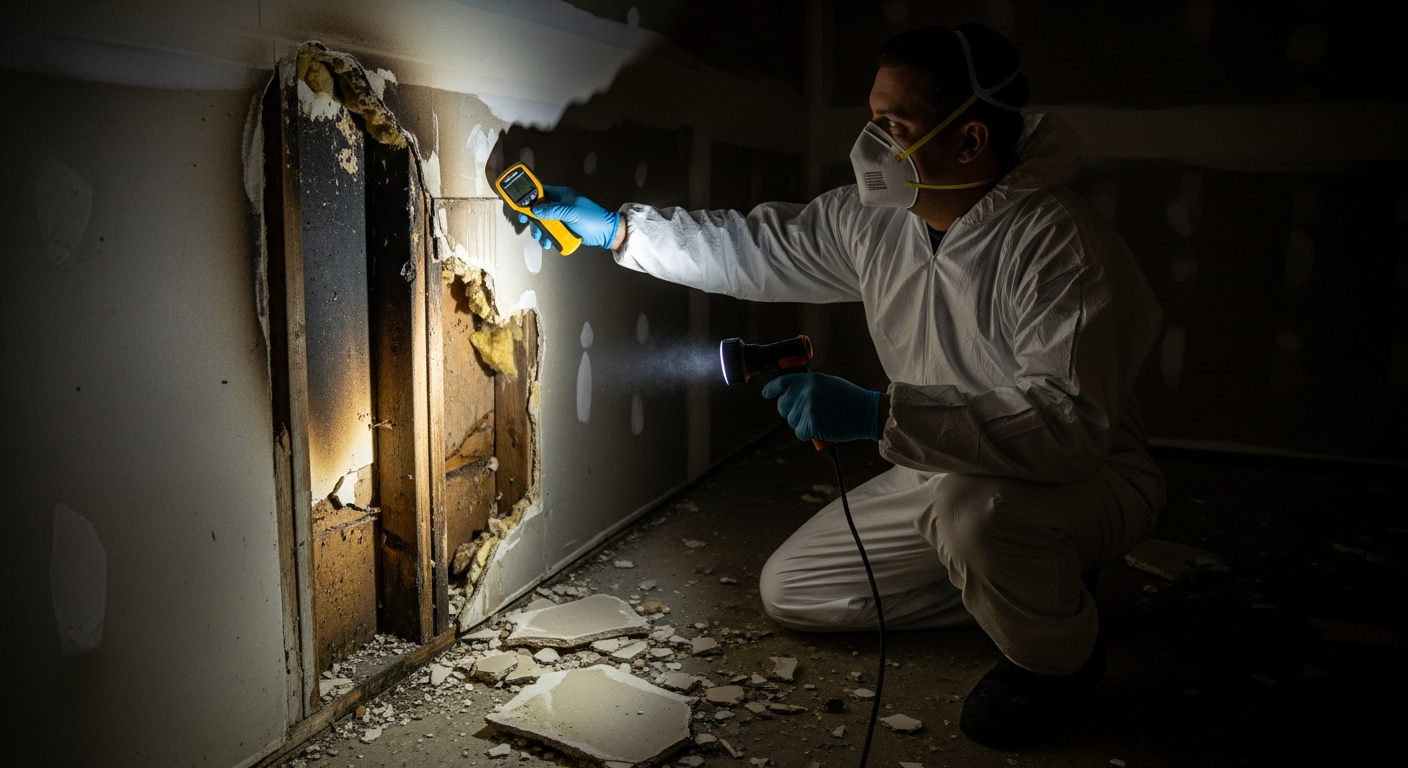
The Seven Questions Every Fire Restoration Contractor Should Answer With a Straight Face
Print this list. Read it over the phone. If you get hesitation, hedging, or "we'll get back to you" on more than two of these, keep dialling.
- "Do you hold IICRC FSR certification, and can I verify it at iicrc.org?" The answer is yes or no. Hesitation is no.
- "Have your technicians completed EPA RRP training?" Especially relevant for pre-1978 homes.
- "Do you handle contents restoration in-house, or do you partner with a contents specialist?" Either answer is fine. "Contents what?" is not.
- "What odor treatment methods do you use — thermal fogging, ozone, hydroxyl generators?" A pro will explain when each is appropriate. A pretender will pick one and call it magic.
- "Will you provide a written scope of work that separates mitigation costs from reconstruction costs?" Two different scopes, two different sets of numbers. If they refuse to separate them, you cannot sanity-check the bid.
- "How do you coordinate with insurance adjusters, and do your estimates use Xactimate?" Xactimate is the software 90% of insurance companies use. A contractor who can produce Xactimate-format estimates speaks the adjuster's language.
- "Can you provide three references from fire restoration projects specifically — not water damage?" Fire is its own discipline. References from water jobs prove they can dry a basement, not clean soot.
That's the whole interview. About fifteen minutes. The contractor who answers all seven without flinching is the one you keep on the shortlist. The one who calls you "buddy" four times and pivots to "what's your insurance policy number" before you've finished a question — that's a different category of person, which leads us to...
Red Flags Worth Politely Running From
House fires attract a small but persistent population of "storm chasers" — out-of-area contractors who follow disasters from one neighbourhood to the next, knock on doors, and offer to "handle everything" before the smoke clears. Some are legitimate companies expanding capacity. Others are the restoration industry's answer to door-to-door magazine sales.
Things that should make you politely close the door (or hang up the phone):
- They showed up without being called. Reputable restoration companies are too busy serving their existing customers to cold-call disaster sites. The exception is your insurance company's preferred vendor — but they'll identify themselves that way upfront.
- They want your insurance policy number before they want to see the damage. This is the "Assignment of Benefits" hustle. They sign your insurance rights over to themselves, then bill the insurer directly and dispute everything. You become a spectator at your own claim.
- They ask for a large deposit before any work starts. Reasonable: a deposit on materials for a major reconstruction. Not reasonable: 50% down before anyone's run a moisture meter.
- The estimate has no line items. "$22,400 for fire damage restoration" is not an estimate. It's a number. A real estimate breaks scope, materials, and labour for each phase.
- They pressure you to sign immediately. "This price is only good today" is the contractor equivalent of a used-car closer. Walk.
- No physical office, no truck signage, generic email address. A company called "Premier Restoration Solutions" with a Gmail address and a magnetic door sign on a 2011 Civic is not, statistically, your best option.
None of this is to say every fast-arriving contractor is a scam. Some legitimate companies do excellent emergency response work. The point is: the things you're checking for don't change just because you're stressed and the house smells like the inside of a chimney. Vet them anyway.
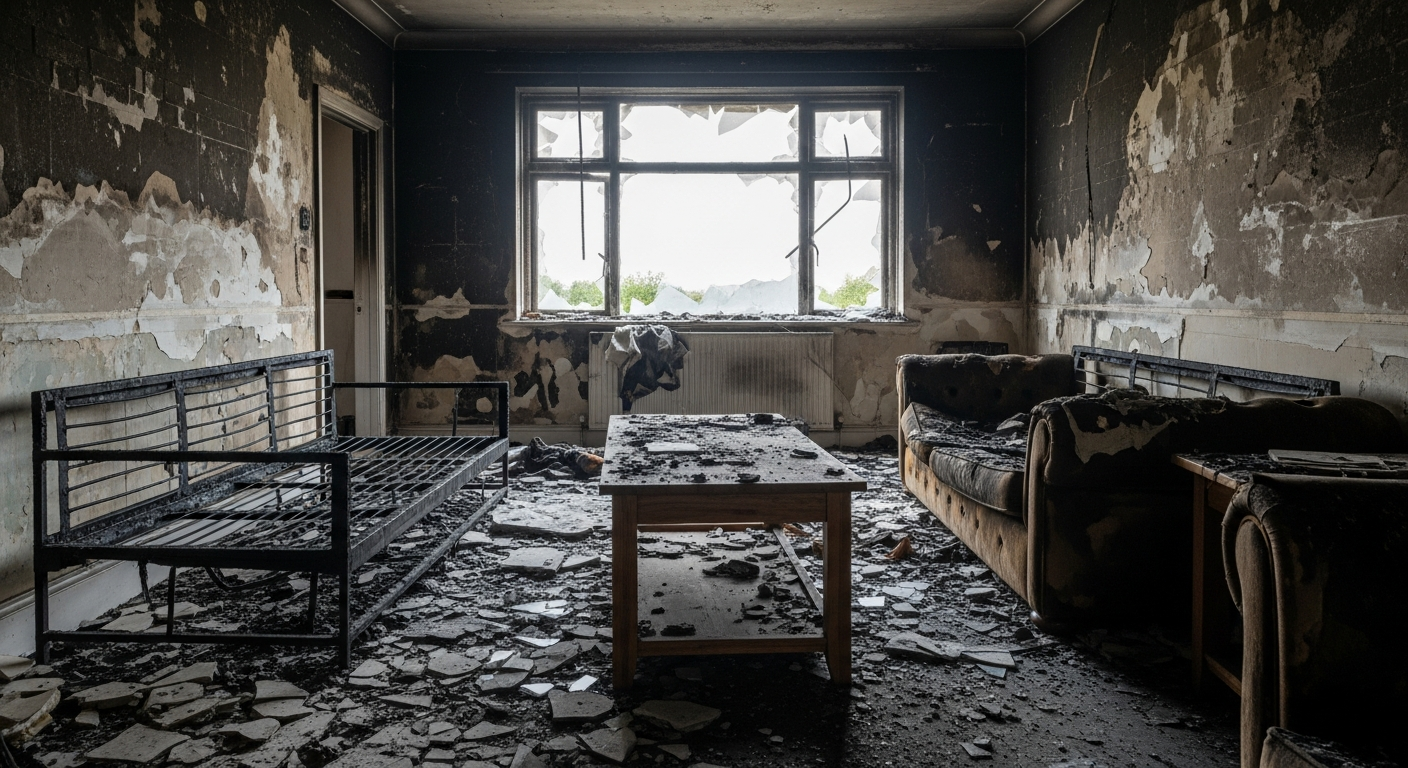
The Cost Reality (Numbers Most "Near Me" Pages Won't Give You)
Most of the top-ranking fire restoration pages avoid pricing entirely. Their reasoning is fair — fire damage varies enormously and a flat number is misleading. Our reasoning is fairer — telling you nothing is also misleading. Here's what the industry actually charges in 2026.
| Component | Typical Range | What Drives the Variance |
|---|---|---|
| Whole-house fire restoration (per sq ft) | $4 – $7 | Fire class, smoke type, structural damage scope, regional labour rates |
| Smoke and soot removal (alone) | $500 – $5,000+ | Square footage affected, smoke type (wet vs dry), porosity of materials |
| Water damage from firefighting | $2,000 – $6,000+ | Volume of water used, time before mitigation, mold risk window |
| Emergency board-up | $400 – $1,500 | Number and size of openings, roof tarping requirements, after-hours dispatch |
| Odor treatment (thermal fog/hydroxyl) | $200 – $1,000 per room | Smoke type and dwell time, equipment used, number of cycles needed |
| Contents restoration (pack-out + clean + storage) | $1,500 – $10,000+ | Volume of contents, salvageability, storage duration during reconstruction |
A meaningful house fire — say a 1,800 square foot single-storey with kitchen-origin structural damage and full-house smoke — typically lands somewhere between $25,000 and $65,000 once mitigation, contents, and reconstruction are stacked. Larger fires, multi-storey homes, and wet-smoke scenarios push it higher.
Your insurance is doing most of this lifting. The contractor's job is to scope the work the insurer will pay for. Your job is to make sure the scope is accurate and complete — not to argue the bill down. The contractor wants to be paid; the insurer wants to pay only for what's documented; you want the house back together. The three of you are, briefly, in a polite cold war.
How a Real Fire Restoration Actually Unfolds
Fire restoration has more distinct phases than water damage. The order matters — clean smoke before drying water and you re-deposit soot on every surface; dry water before clearing smoke and you bake odors into the structure. A contractor who can articulate the sequence (and explain why) is a contractor who's been in the room before.
- Emergency securing and board-up — within hours of fire-out. Roof tarps, plywood on broken windows, lockbox on the front door. Insurance will reimburse this if you keep receipts.
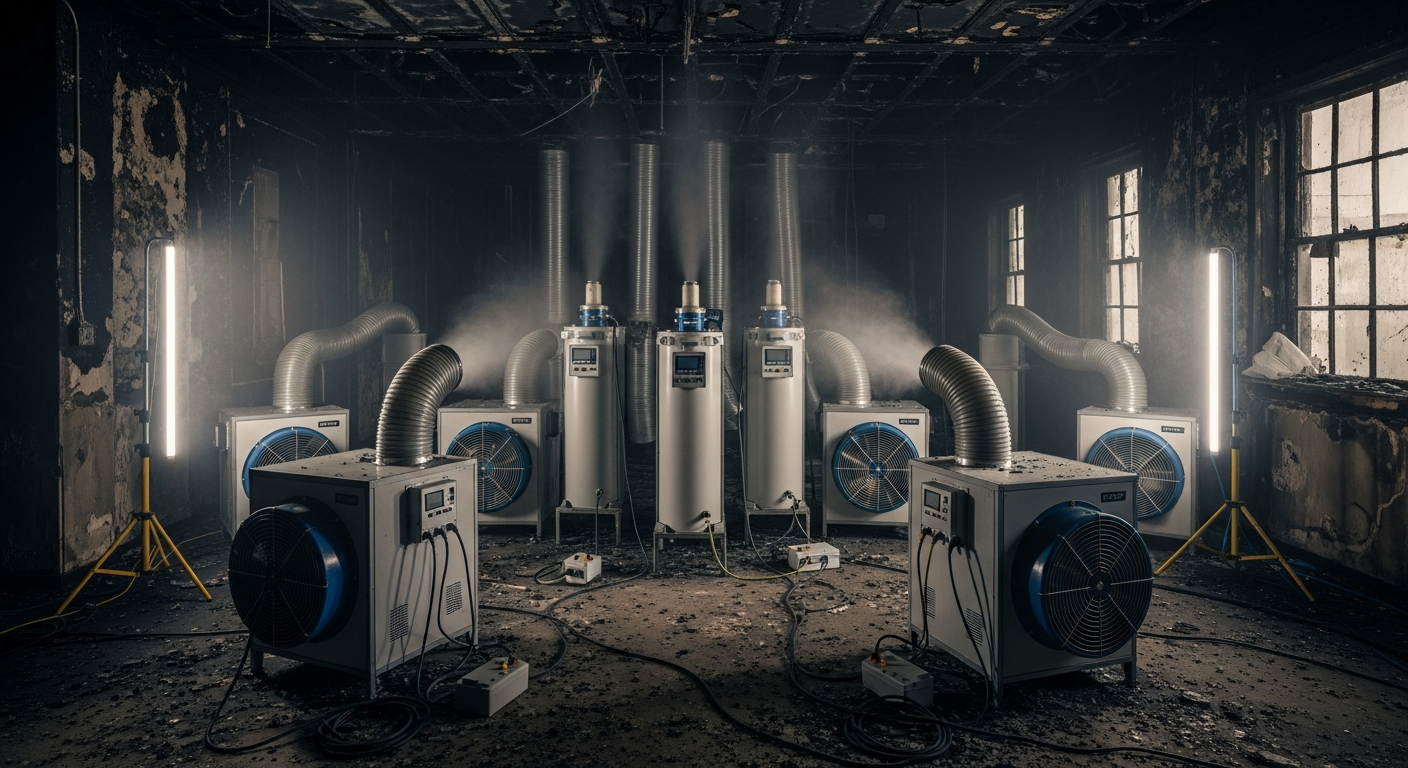
- Water damage mitigation — extract firefighting water, set up dehumidifiers and air movers, dry the structure. This must happen before deep smoke cleaning, because wet soot smears.
- Smoke and soot assessment — categorize the smoke. Dry smoke (fast, clean fires) cleans differently than wet smoke (slow, smouldering fires) which cleans differently again than protein smoke (kitchen fires) and fuel-oil smoke (furnace fires). Each has its own protocol.
- Structure cleaning — walls, ceilings, structural framing if exposed, HVAC ducting (which has been redistributing soot the whole time the system ran).
- Contents assessment and cleaning — what gets packed out, what gets cleaned in place, what gets written off. Documentation is heavy here for the insurance claim.
- Odor treatment — usually thermal fogging or hydroxyl generation, sometimes ozone. Run after cleaning, not before — ozone won't work through a layer of soot.
- Demolition of unsalvageable materials — drywall that can't be cleaned, insulation that absorbed too much, flooring that's structurally compromised.
- Reconstruction — usually a separate scope, often a separate company. Drywall, paint, flooring, cabinetry. This is where the bulk of the time goes.
Working With Your Insurance Company (Without Losing Your Mind)
Fire claims are larger and more complex than water claims, and they take longer to settle. The right contractor makes this less painful. The wrong one makes it considerably more painful in ways you'll be re-living in therapy years later.
Things to look for in your contractor's insurance handling:
- Xactimate-format estimates. Industry standard. If your contractor produces estimates in something else, the adjuster has to translate, and translation costs you time.
- Direct adjuster communication. A good contractor will speak with your adjuster while you sit on the couch and recover. A bad one will hand you a 14-page document and expect you to explain "trim casing replacement" to a stranger over the phone.
- A scope that documents everything before assuming anything. Do not let a contractor tell you your policy "won't cover" something before they've documented it and submitted it. That decision is the insurer's, not the contractor's, and contractors who assume non-coverage are usually cutting their own scope to win the bid.
- Patience with supplements. A "supplement" is a follow-up estimate when hidden damage is revealed during work. Fire jobs almost always have supplements. A contractor who refuses to file them is a contractor who will absorb the loss as cut corners — usually in places you can't see.
One more thing on Assignment of Benefits forms: in most states they are legal. They are also rarely in your interest. If your contractor insists on signing one, that's your cue to ask why. The honest answer is "so we can fight your insurer for more money without you in the room." The actually honest answer is "so we can fight your insurer for more money for ourselves." Neither is great.
Frequently Asked Questions
What type of contractor do I need after a house fire?
Fire damage restoration requires a company with specialized expertise beyond general contracting: IICRC Fire and Smoke Restoration (FSR) certification, soot and smoke cleaning experience, HEPA air filtration and odor treatment capability, and experience working with insurance companies on fire claims. Some full-service restoration companies also handle contents cleaning and temporary storage. You may need a separate general contractor for structural reconstruction.
How quickly should I contact a restoration company after a house fire?
Contact a restoration company as soon as fire department personnel have cleared the property for safe entry. Delay increases damage in three ways: ongoing soot penetration into porous materials, water damage from firefighting that continues to spread, and secondary smoke damage from residual smouldering. Emergency board-up should happen within hours; full restoration engagement should begin within 24 hours where possible.
How much does fire damage restoration cost?
Whole-house fire restoration typically runs $4 to $7 per square foot, with smoke and soot removal alone ranging from $500 to $5,000 and firefighting-water mitigation adding $2,000 to $6,000 or more. A mid-sized house fire commonly lands between $25,000 and $65,000 in total restoration cost, though wet-smoke and multi-storey scenarios push that higher. Most of this is covered by homeowners insurance.
What is IICRC FSR certification, and why does it matter?
The IICRC Fire and Smoke Restoration (FSR) certification is the industry credential for fire damage cleaning expertise — covering smoke behavior, soot chemistry, and the specific cleaning protocols different smoke types require. A non-certified company may successfully clean dry smoke but will struggle with wet smoke or protein smoke and may permanently set stains by using the wrong technique. You can verify any company's certification at iicrc.org.
Can I stay in my home during fire damage restoration?
It depends on the extent of damage. Localized smoke damage in one room sometimes allows occupancy in unaffected areas with HEPA air purification running. Structural damage, compromised HVAC systems, extensive whole-house soot, or health concerns for sensitive family members typically require full displacement. Your insurer's Additional Living Expenses (ALE) provision covers temporary housing costs when the home is uninhabitable.
Should I clean up soot myself before the restoration company arrives?
No. Soot cleaning requires specific techniques and dry chemical sponges — using water or household cleaners on dry soot permanently sets the stain and can spread contamination throughout the home. Documentation photos for the insurance claim should also be taken before anything is disturbed. Wait for the restoration crew to assess and document, then let them handle the cleaning.
Fire restoration is one of the few jobs where the "best company near me" might be the one twenty minutes further away — the one with FSR certification, a hundred fire jobs in the rear-view, and a Xactimate licence. Find that company, ask the seven questions, read the scope twice, and let them do their slow, thorough, soot-removing work. (Also: please clean your dryer lint trap. Marco asked me to remind you.)