
How do you find emergency water damage restoration near you? Search for IICRC-certified companies in your area, call to confirm 24/7 availability and a specific arrival time, verify they carry liability and workers' compensation insurance, and ask whether they handle both mitigation and reconstruction. Most established companies offer 1–4 hour emergency response times.
Your living room is currently doing an excellent impression of a swimming pool and you're standing in the hallway, phone in hand, wondering who to call. I get it. This is the worst possible moment to research contractor qualifications — which is exactly why this article exists. We've done the research part. You do the calling part. (And maybe the "standing somewhere dry" part. That's important too.)
Every hour of delay after a water event increases damage exponentially. Water spreads laterally and vertically through building materials, mould starts colonising within 24–48 hours, and structural integrity degrades with prolonged saturation. Speed matters — but hiring the wrong company in a panic can cost you more than the water damage itself.
What to Do Right Now (Before Anyone Arrives)
While you're searching for a company, these five steps limit damage and protect your insurance claim:
- Stop the water source. Shut off the main water supply valve or the specific supply line if you can identify and reach it safely. If you can't find the shutoff, don't waste time hunting — move to step two.
- Turn off electricity to affected areas at the breaker panel. If water is anywhere near electrical outlets, appliances, or equipment, do this immediately. If you can't reach the breaker safely, call your utility company.
- Photograph everything. Before you touch, move, or clean anything. Your insurance claim depends on documentation of the damage as it was found. Take wide shots, close-ups, and video. (This is the one time in your life where over-photographing is encouraged.)
- Call your insurance company to open a claim. You can do this while waiting for the restoration crew. Most insurers authorise emergency mitigation before an adjuster visits because delays increase total claim costs.
- Do NOT run household fans. Fans without concurrent dehumidification can push moisture deeper into wall cavities. The restoration crew will bring the right equipment — let them.
How to Find a Certified Company Fast
You're in a hurry. Here's the fastest path to a legitimate company:
Search for IICRC-Certified Firms
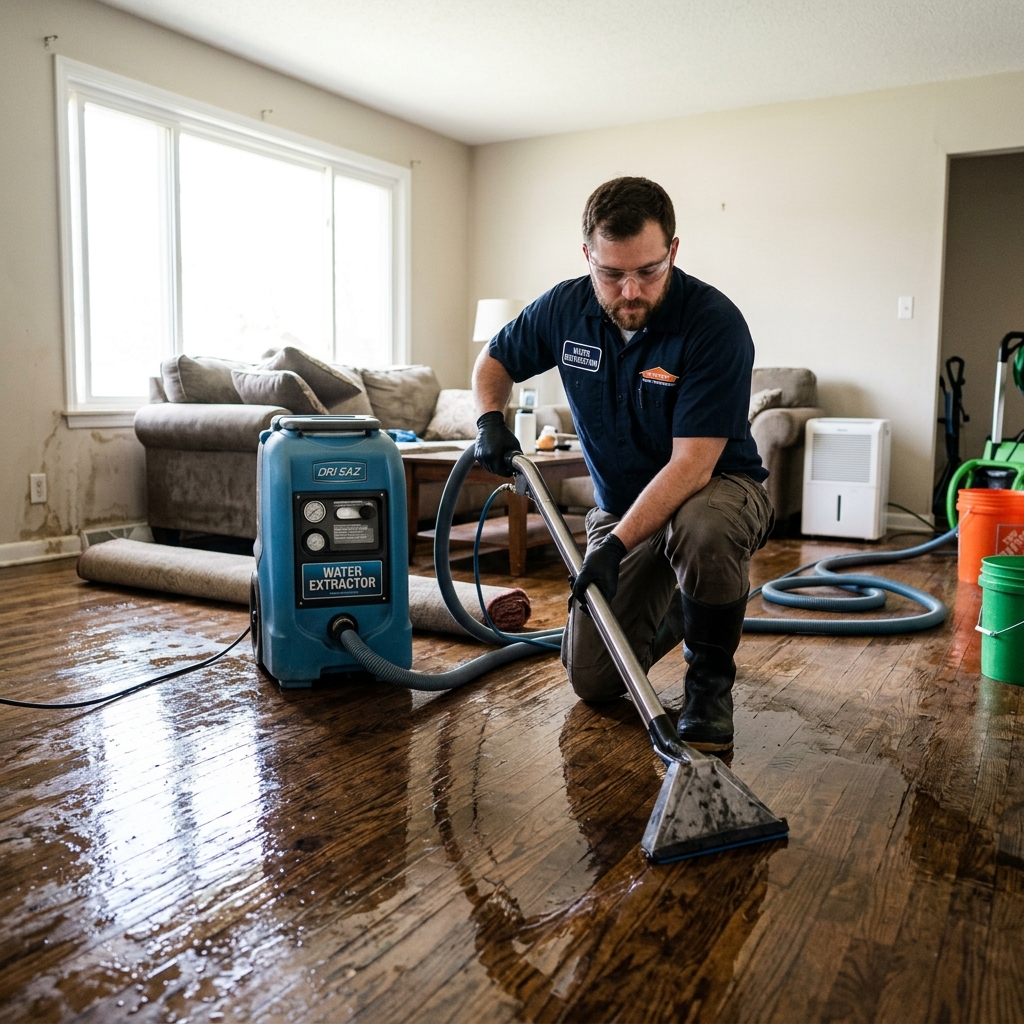
The Institute of Inspection, Cleaning and Restoration Certification (IICRC) maintains a searchable directory at iicrc.org where you can find certified firms by postcode. IICRC certification means the company's technicians are trained in proper water damage restoration protocols — they know how to dry materials without causing secondary damage and how to document the process for insurance.
You can also use our RestoreNearMe directory to find verified, certified companies in your area.
Confirm True 24/7 Emergency Response
Not all restoration companies offer real 24/7 response — some have an answering service that takes messages until Monday morning. When you call, ask directly: "Can you have a crew on-site at my address within two hours?" A legitimate emergency company gives you a specific estimated arrival time, not "someone will call you back." (If someone says they'll call you back, your floor is soaking. Call the next number.)
Check Local Reviews Quickly
Google reviews matter, but in an emergency, look specifically for recent local reviews that mention:
- Specific response times ("they arrived in 45 minutes")
- Insurance coordination ("they worked directly with my adjuster")
- Drying timelines ("the whole process took 5 days")
Generic five-star reviews that read like they were written by the owner's mother are less useful than a three-paragraph review from a homeowner who had their basement flooded at 2 AM.
Questions to Ask Before the Crew Arrives
You're stressed. The floor is wet. But take three minutes to ask these questions — they'll save you time, money, and headaches later:
- "Are your technicians IICRC WRT (Water Damage Restoration Technician) certified?"
- "What is your estimated arrival time for my address?"
- "Do you work directly with insurance companies, or do I manage the claim myself?"
- "Will you provide a written scope of work and estimate before beginning?"
- "What equipment are you bringing? (Pumps, commercial dehumidifiers, moisture meters, thermal imaging?)"
- "Do you handle both extraction/drying and reconstruction, or just mitigation?"
- "What does the daily monitoring process look like?"
A reputable company answers all of these directly. Evasive answers — or pressure to sign paperwork before they've even seen your home — are warning signs the size of the water stain on your ceiling.
What Happens in the First 60 Minutes On-Site
When a professional emergency crew arrives, here's the process — in order:
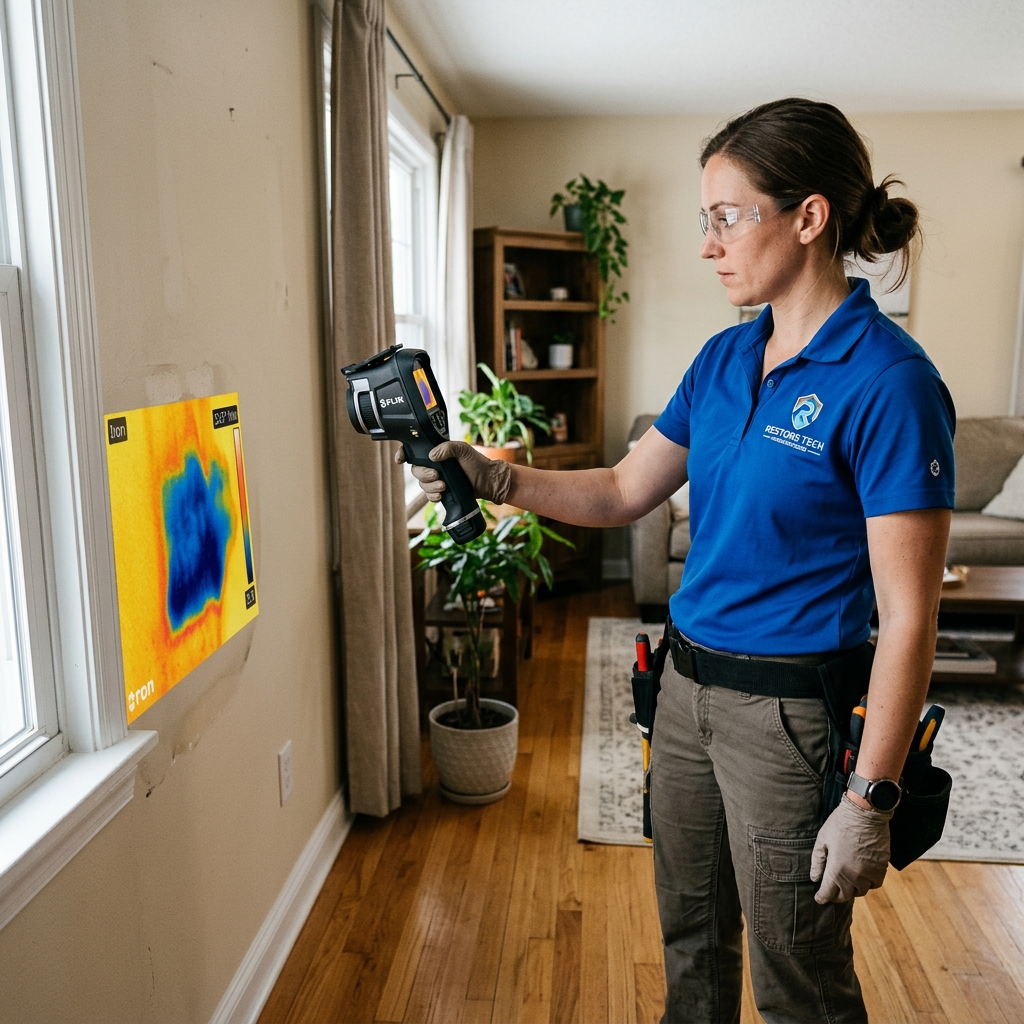
- Moisture mapping: Technicians use moisture meters and thermal imaging cameras to determine the full extent of water migration — including inside walls, under flooring, and in ceiling cavities that aren't visibly wet. This step takes 15–30 minutes and determines everything that follows.
- Water extraction: Industrial pumps and truck-mounted extractors remove standing water and surface moisture. For a typical flooded room, this takes 30–60 minutes. For a full basement, it can take several hours.
- Contamination assessment: The crew identifies the water category:
- Category 1 (Clean): Burst supply line, leaking water heater — lowest risk
- Category 2 (Grey): Washing machine overflow, dishwasher leak — contains contaminants
- Category 3 (Black): Sewage backup, floodwater — biohazard protocols required
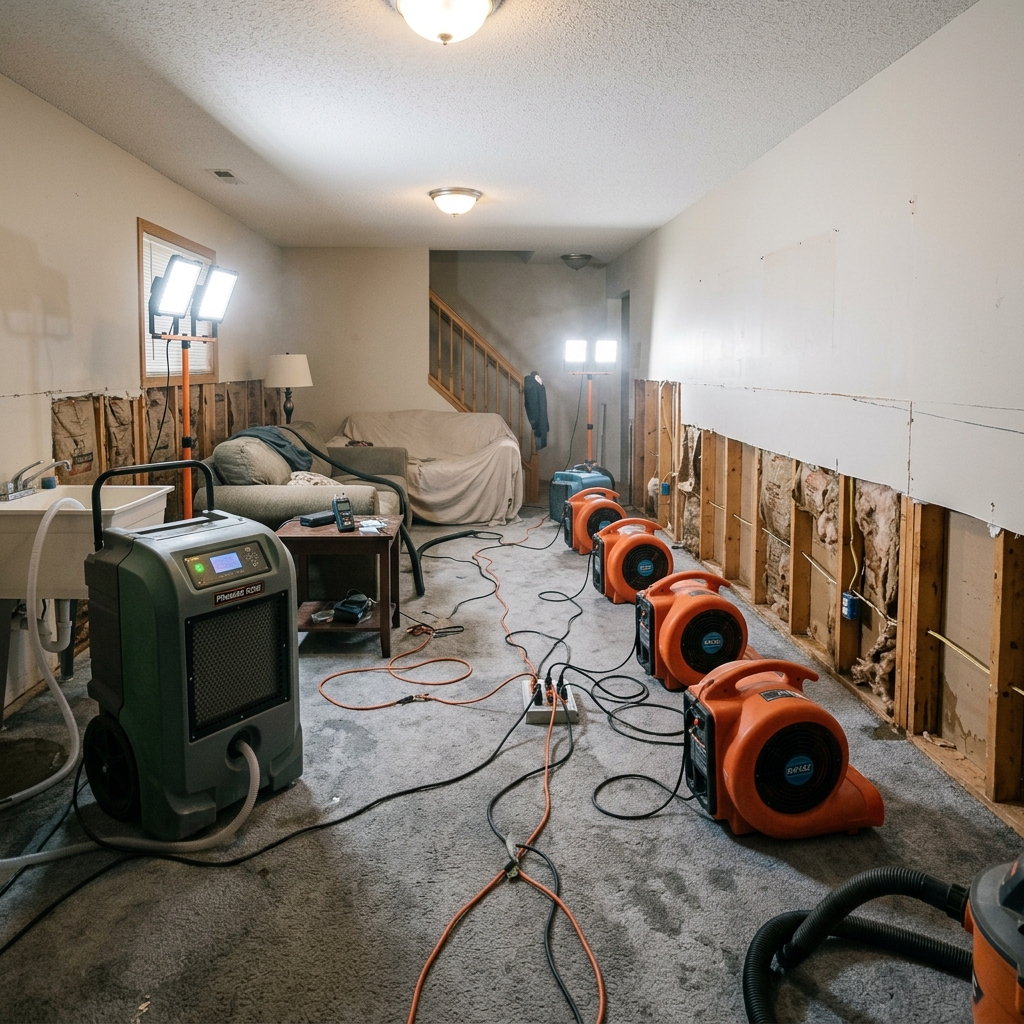
- Equipment placement: Commercial air movers and LGR (low-grain refrigerant) dehumidifiers are positioned based on the moisture map. Equipment density follows IICRC standards — typically one air mover per 10–16 linear feet of wet wall.
- Documentation and scope: Technicians photograph and record initial moisture readings as a baseline for daily monitoring, then walk you through what needs to be removed versus what can be dried in place.
How Much Emergency Water Damage Restoration Costs
Let's address the question you're silently dreading:
| Damage Level | Typical Cost (Mitigation Only) | Includes Reconstruction |
|---|---|---|
| Minor (single room, clean water) | $450–$1,500 | $1,500–$3,000 |
| Moderate (multiple rooms, some demo needed) | $1,500–$4,000 | $4,000–$8,000 |
| Severe (full floor/basement, structural) | $4,000–$7,500 | $7,500–$20,000+ |
| Catastrophic (Category 3 water, multi-floor) | $7,500–$15,000+ | $15,000–$50,000+ |
National average: $3,860 for mitigation (extraction, drying, monitoring). Reconstruction (replacing drywall, flooring, paint) is additional and typically quoted separately.
Here is the uncomfortable truth that also happens to be good news: acting fast reduces the total cost. Every hour of delay increases moisture penetration, which increases the scope of demolition, which increases the reconstruction bill. The $200–$400 emergency dispatch fee pays for itself many times over compared to the cost of three additional rooms of drywall replacement because you waited until morning.
Red Flags: When to Hang Up and Call Someone Else
Water damage emergencies attract opportunistic companies the way a car accident attracts personal injury lawyers. Here's what to watch for:
- Demanding cash upfront or requiring a significant deposit before stepping foot in your home
- Asking you to sign an Assignment of Benefits (AOB) — this transfers your insurance claim rights to the company and removes your control over the claim process
- Unable to provide proof of IICRC certification or insurance when asked directly
- No physical address or a business that appears to have registered in the past few weeks — storm chasers set up temporary operations in disaster areas
- Refusing to provide a written estimate before beginning work
- Pressuring you to start immediately without allowing time to review paperwork — urgency is real, but a legitimate company can start water extraction while you review their contract
- Quoting dramatically below market — if the quote is 50% below every other company's estimate, the scope is probably missing something critical
Frequently Asked Questions
How quickly can a water damage restoration company arrive?
Most established restoration companies offer 1–4 hour emergency response times in their service area. Dense metro areas often see response under one hour from certified companies. Rural areas typically run 2–4 hours. After major storm events, response times extend significantly as crews are dispatched to multiple properties simultaneously — calling as soon as possible is critical to getting in the queue early.
What should I do while waiting for emergency restoration?
Shut off the water source if possible. Turn off electricity to affected areas at the breaker panel. Document everything with photos and video before touching anything. Move valuables to dry areas if safe to do so. Do not run fans or dehumidifiers — improper airflow can push moisture deeper into wall cavities. Call your insurance company to open a claim while you wait.
Is emergency water damage restoration covered by insurance?
If the water damage was caused by a covered event — burst pipe, appliance failure, accidental discharge — emergency mitigation is typically covered under your homeowners policy. Most insurers authorise emergency work before an adjuster visits because delays increase total claim costs. Report the claim immediately and keep all documentation from the restoration company for reimbursement.
How much does emergency water damage restoration cost?
Mitigation (extraction, drying, monitoring) typically costs $1,500–$7,500 depending on severity and area size. The national average is approximately $3,860. Reconstruction (replacing drywall, flooring, and finishes) is quoted separately and can add $3,000–$20,000+ for moderate to severe damage. Acting quickly reduces total costs by limiting moisture spread and secondary damage.
How do I know if a water damage company is legitimate?
Verify IICRC WRT certification at iicrc.org. Confirm the business has a physical address and local reviews — avoid companies with no online presence or that appeared recently. Check that they carry general liability and workers' compensation insurance. A legitimate company provides a written scope and estimate before work begins and never pressures you to sign over your insurance claim rights.
Your floor is wet, your phone is in your hand, and you've now read more about water damage restoration in five minutes than most people learn in a lifetime. Make the call, ask the questions, and let the people with the industrial-grade equipment take it from here. Your job is to stay dry, document everything, and resist the urge to mop. (Mopping is a noble instinct. It just won't help here.)