
How do you get rid of mold smell in a house? Find and eliminate the mold producing it. The musty smell is caused by microbial volatile organic compounds (MVOCs) — gases produced by active mold growth. No amount of air freshener, baking soda, or ventilation eliminates the smell permanently unless the mold itself is removed and the moisture source that feeds it is fixed.
If you're reading this, your house smells like a damp cellar in a Victorian novel. You've probably already tried candles. Maybe you've tried baking soda. Maybe you've opened every window and run every fan and the smell is still there — like a houseguest who doesn't understand social cues.
The reason nothing has worked is that you've been treating the smell. The smell is a symptom. The disease is mold growing somewhere in your home, producing gaseous compounds faster than your scented candle can mask them. Eliminating the smell means eliminating the mold. Full stop.
What You're Actually Smelling (It's Not "Mustiness")
That earthy, musty odour has a name: MVOCs — microbial volatile organic compounds. These are gaseous byproducts produced by actively growing mold and bacteria. They're what gives mold its distinctive smell, and they're produced continuously as long as the mold is alive and feeding.
MVOCs are also why you can smell mold that you can't see. The gases travel through wall cavities, under baseboards, and through HVAC ductwork. You might smell mold in your living room when it's actually growing inside a wall in the bathroom. The nose knows there's a problem. It just isn't great at triangulation.
What Doesn't Work (Let's Get This Out of the Way)
| Method | What People Think It Does | What It Actually Does |
|---|---|---|
| Air fresheners / candles | Eliminates mold smell | Masks odour for hours. Smell returns because mold keeps producing MVOCs. |
| Bleach on porous surfaces | Kills mold | Kills surface mold only. Roots (hyphae) survive inside drywall, wood. Mold regrows in weeks. |
| Baking soda | Absorbs mold odour | Absorbs mild surface odour only. Zero effect on MVOCs from active mold inside walls. |
| Vinegar | Natural mold killer | Mild antimicrobial on hard, non-porous surfaces. Cannot penetrate porous materials where mold lives. |
| Ozone generator alone | Eliminates mold and smell | Neutralises airborne odour compounds temporarily. Does not kill mold inside materials. Smell returns. |
| Essential oil diffuser | Purifies air naturally | Makes your house smell like eucalyptus and mold. An expensive combination of two smells. |
Every one of these methods treats the symptom while the disease continues. They're the equivalent of turning up the radio to avoid hearing the engine knock. The engine is still knocking.
Step 1: Find the Source
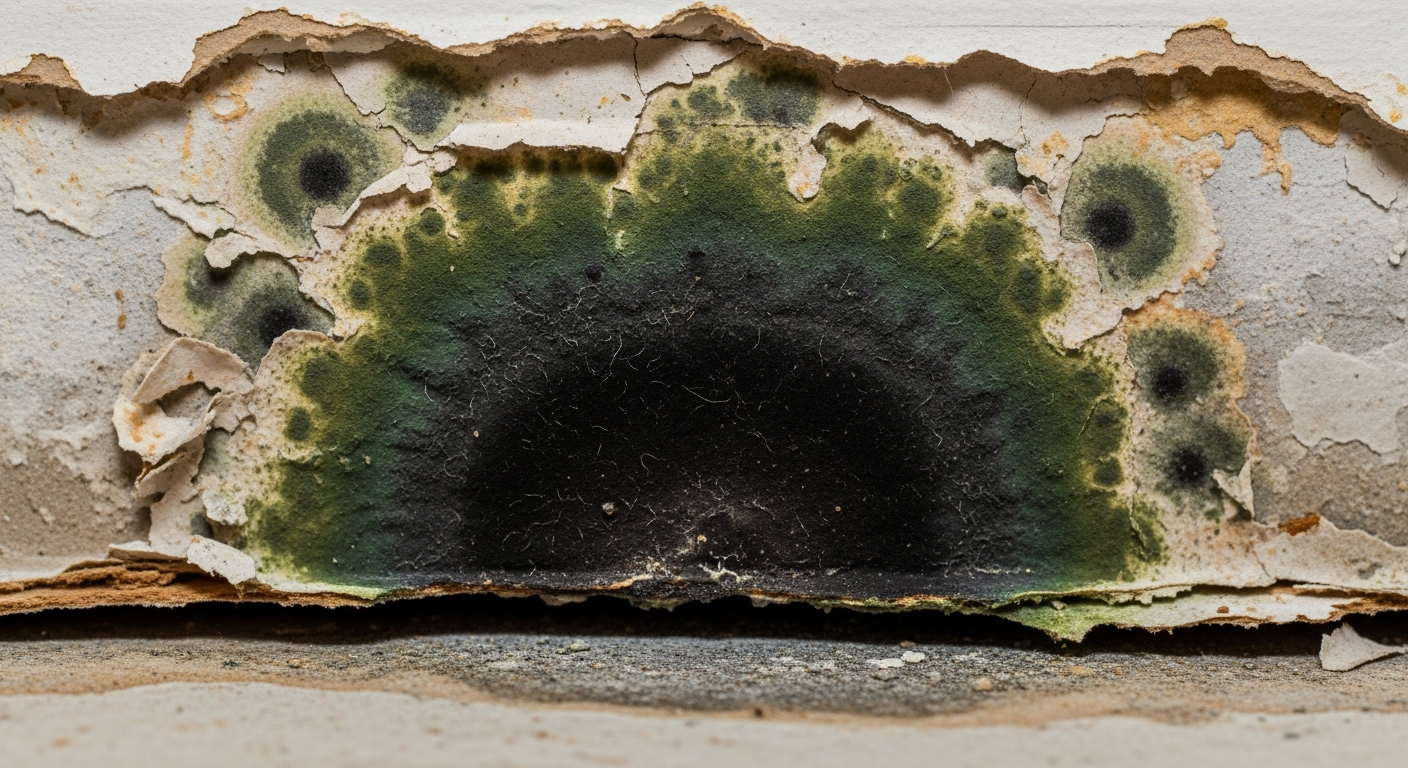
Permanent odour elimination requires locating the mold. Start with the most common hiding spots:
| Location | What to Look For | Why Mold Grows Here |
|---|---|---|
| Bathroom | Under sinks, around toilet base, inside exhaust fan housing, behind tiles with cracked grout | Chronic moisture from showers, often poor ventilation |
| Basement / crawl space | Walls, floor-wall joints, wood framing, near water entry points | Foundation moisture intrusion, high humidity, poor vapour barriers |
| HVAC system | Dark discolouration inside return air vents, musty smell when system runs | Condensation, clogged drain line, contaminated ductwork |
| Inside walls near plumbing | Soft spots, bubbling paint, staining on drywall | Slow supply or drain leaks feeding mold behind finished surfaces |
| Attic | Roof deck, rafters near vents, where roof meets exterior walls | Bathroom fans venting into attic (not outside), roof leaks, condensation |
| Under flooring | Cupping or buckling in hardwood, soft spots in subfloor | Moisture migrating upward from crawl space or slab |
Step 2: Find Hidden Mold You Can Smell But Can't See
If you've inspected every visible surface and still can't find the source, the mold is inside a wall, under flooring, or in your HVAC system. This is more common than you'd think — and it's the scenario where "I can smell it but I can't find it" drives people slowly insane.
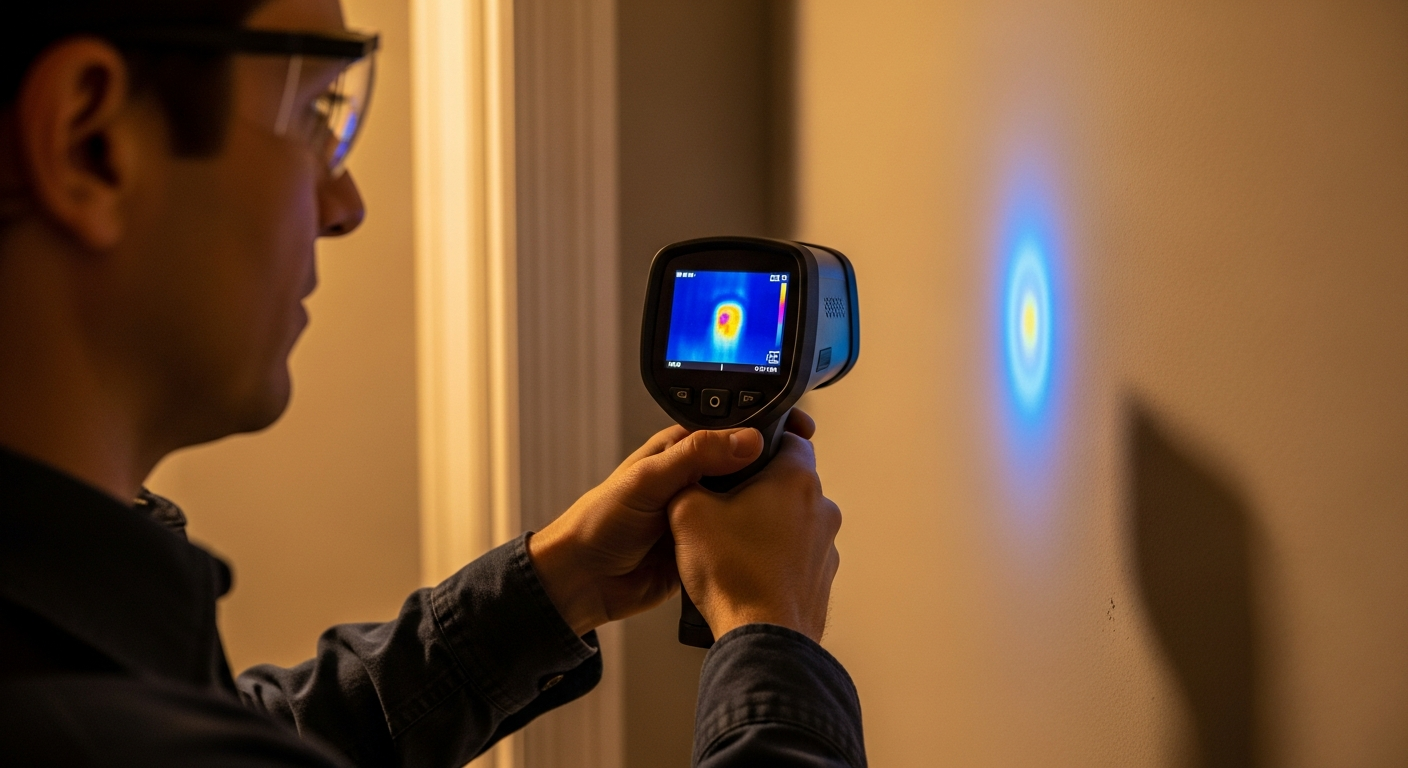
Professional mold inspectors use tools that see what your eyes can't:
- Thermal imaging cameras: Show temperature differentials in walls that indicate hidden moisture (cold spots = wet spots)
- Pin and pinless moisture meters: Measure moisture levels inside wall assemblies without demolition
- Borescopes: Tiny cameras inserted through small holes to visually inspect inside wall cavities
- Air sampling: Measures mold spore concentrations in the air — elevated counts confirm active mold even when it's not visible
A professional mold inspection costs $300–$600 for most homes. That might seem like a lot to find something you already know is there. But "I know there's mold" is different from "I know there's mold behind the bathroom wall near the shower supply line, and the colony is approximately 8 square feet." The second one is what your remediation contractor needs to give you an accurate scope and price.
Step 3: Fix the Moisture Source
Removing mold without fixing the moisture that created it is a temporary victory. The mold will return — typically within weeks. Common moisture sources behind persistent mold odour:
- Bathroom exhaust fan venting into the attic instead of outside (extremely common and extremely problematic)
- Slow plumbing leak inside a wall — supply line or drain
- Foundation moisture intrusion in the basement or crawl space
- Clogged HVAC condensation drain or improperly pitched drain line
- Inadequate crawl space vapour barrier — or no vapour barrier at all
- Indoor humidity consistently above 60% — ideal mold conditions
Fix the water. Then fix the mold. In that order. (Fixing the mold first is like mopping while the tap is still running. Productive feeling, zero net progress.)
Step 4: Remove Contaminated Materials
Any porous material with mold growth must be removed, not cleaned. This includes:
- Drywall with mold on the paper face or behind it
- Insulation that contacted moisture or shows mold growth
- Carpet and padding in affected areas
- Ceiling tiles (porous, absorbs moisture, cannot be remediated)
Why removal instead of cleaning? Mold grows root structures (hyphae) that penetrate into porous materials. Surface cleaning kills surface mold while leaving the root system intact inside the material. The roots regrow. The MVOCs resume. The smell returns. You're back to where you started, except now you've also spent money on cleaning.
Non-porous surfaces — tile, glass, metal, sealed concrete — can be effectively cleaned and sanitised without removal.
Step 5: Professional Remediation and Odour Treatment
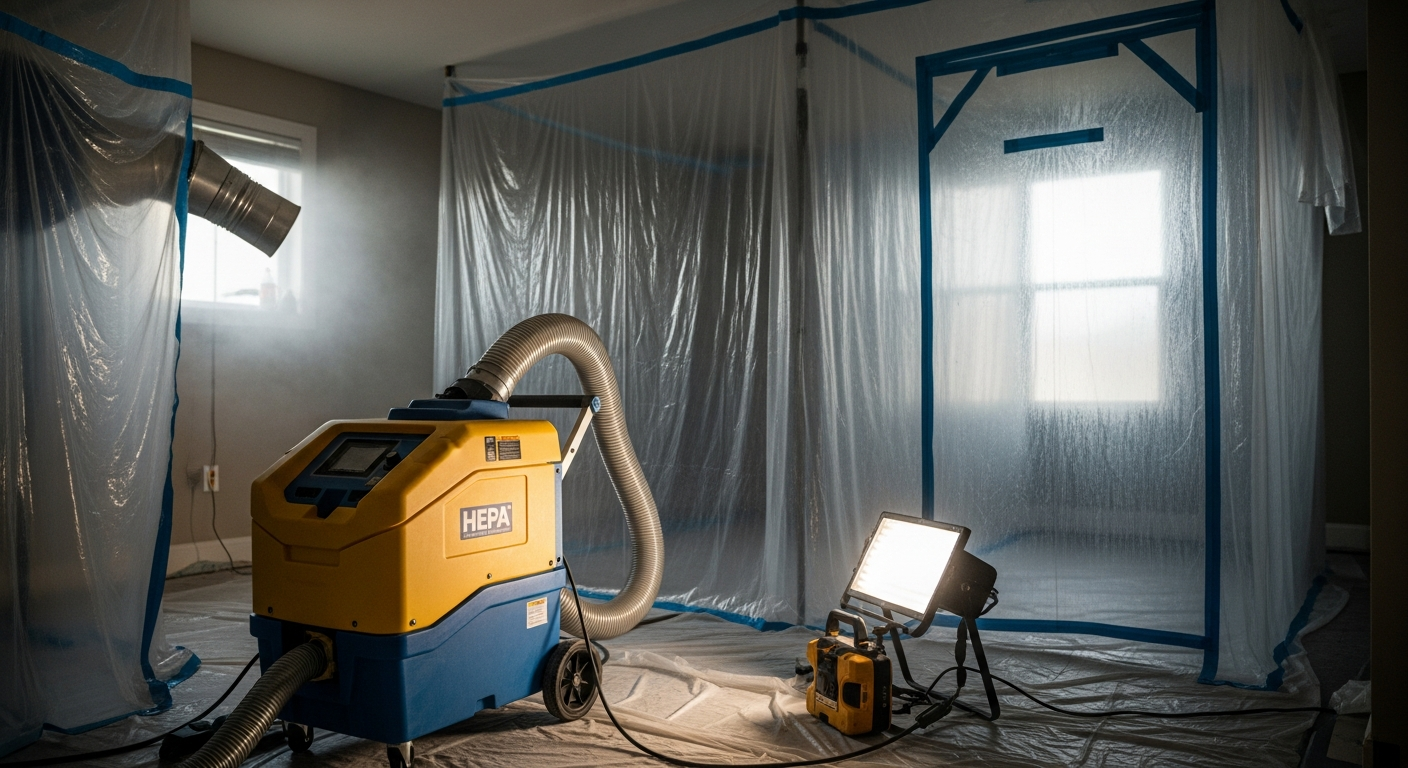
For established mold — particularly inside walls, in crawl spaces, or in HVAC systems — professional remediation is the definitive treatment:
| Treatment | How It Works | Effective For | Cost |
|---|---|---|---|
| Physical removal + containment | Contaminated materials removed under negative air pressure to prevent spore spread | The mold itself — this is the primary treatment | $1,500–$9,000 (typical residential) |
| Thermal fogging | Deodourising agent vaporised into fog that penetrates cavities and porous surfaces | Residual odour in framing, ductwork after mold removal | $200–$600 |
| Ozone treatment | High-concentration ozone breaks down MVOC molecules | Enclosed spaces, HVAC systems, deep-set residual odour | $300–$1,000 |
| HEPA air scrubbing | Captures airborne spores and particulates continuously | Air quality during and after remediation | $75–$200/day |
| Antimicrobial encapsulant | Applied to wood framing after remediation to prevent regrowth | Structural wood that had surface mold but is structurally sound | $1–$3/sq ft |
DIY vs. Professional: The 10-Square-Foot Rule
The EPA's guidance is straightforward: mold on non-porous surfaces covering less than 10 square feet can typically be handled by a homeowner with appropriate PPE. Anything beyond that threshold — or any mold on porous surfaces, inside walls, or in HVAC systems — warrants professional remediation.
| Scenario | DIY? | Professional? |
|---|---|---|
| Surface mold on tile or glass, under 10 sq ft | Yes — clean with appropriate product, fix moisture source | Only if it recurs after cleaning |
| Mold on drywall or wood, any size | No — requires removal, not cleaning | Yes |
| Mold inside walls (smell but no visible growth) | No — requires inspection equipment to locate | Yes — inspection + remediation |
| Mold in HVAC system | No — requires specialised duct cleaning | Yes — NADCA-certified duct cleaning |
| Mold over 10 sq ft on any surface | No — EPA recommends professional remediation | Yes |
| Anyone with respiratory sensitivities in household | No — spore exposure risk too high | Yes — proper containment protects occupants |
Ongoing Prevention (Keeping It Gone)
After mold is eliminated and the moisture source is corrected:
- Maintain indoor humidity below 50% — buy a $15 hygrometer and check it weekly. Use a dehumidifier in chronically humid areas.
- Run bathroom exhaust fans during and for 30 minutes after every shower or bath. If your fan is louder than a conversation, you'll turn it off early. Replace it with a quiet model (1.0 sone or less).
- Inspect under sinks and around appliances every six months — most hidden leaks are found by accident. Finding them on purpose is better.
- Upgrade HVAC filters to MERV-13 or higher to capture mold spores that circulate through the system.
- Consider UV light installation in the air handler ($200–$500) for ongoing antimicrobial protection.
- Don't store cardboard in basements — it's mold's favourite food. Use plastic bins instead.
Frequently Asked Questions
Why does mold smell persist even after cleaning?
Surface cleaning kills surface mold but leaves root structures (hyphae) inside porous materials like drywall and wood. The mold regrows from surviving roots within weeks, and MVOC production resumes. Additionally, mold inside walls, under floors, or in HVAC systems isn't reached by surface cleaning at all. Persistent smell after cleaning usually means the mold source hasn't been fully addressed.
Can I get rid of mold smell without finding the mold?
No — not permanently. Treating odour without locating and removing the mold source is a temporary measure. The smell returns because the mold continues growing and producing MVOCs. If you smell mold but can't see it, it's likely inside walls, under flooring, or in the HVAC system. A professional mold inspection ($300–$600) using thermal imaging and air sampling can locate hidden growth.
Is mold smell dangerous?
MVOCs can cause headaches, dizziness, nausea, and eye/nose/throat irritation. More concerning than the smell itself is what it indicates: active mold growth, which produces allergenic and potentially mycotoxic spores. People with asthma, allergies, or compromised immune systems are particularly vulnerable. The smell is the warning system — the health risk is the mold producing it.
How much does professional mold remediation cost?
Professional mold remediation typically costs $1,500–$9,000 for residential properties, depending on the extent and location. Small contained areas: $1,500–$3,000. Medium infestations (multiple rooms or crawl space): $3,000–$6,000. Large or complex remediation (structural, HVAC, whole-home): $6,000–$15,000+. This includes containment, removal, antimicrobial treatment, and post-remediation clearance testing.
Does ozone treatment work for mold smell?
Ozone treatment is effective at neutralising airborne MVOC molecules, but it's a complementary treatment, not a standalone solution. It does not kill mold inside porous materials or address root structures. Used after physical mold removal, ozone treatment eliminates residual odour effectively. Used without removing the mold first, the smell returns as soon as the ozone dissipates and the mold resumes MVOC production.
The musty smell in your home is a message, and the message is: "There is mold here, and it is alive, and it would like you to know." Masking the smell is ignoring the message. Cleaning the surface is reading the message and filing it. Removing the mold and fixing the moisture source is actually solving the problem. Your nose will tell you when you've succeeded — because the house will smell like nothing. And "nothing" is exactly the right smell for a home.