
What's the difference between a dehumidifier and an air mover? Air movers (high-velocity fans) push air across wet surfaces to accelerate evaporation. Dehumidifiers pull water vapor OUT of the air to keep it dry enough for evaporation to continue. They're not interchangeable — they handle different parts of the same job, and structural drying requires both running together.
Walk into a room being professionally dried after water damage and you'll see two kinds of equipment doing what looks like the same thing: humming. (One of them is also throwing a small windstorm at your baseboards, but neither announces what it's actually doing.) Understanding which is which — and why the pros run both — is the single biggest insight for deciding whether your DIY drying setup is actually going to work or just enthusiastically circulate the moisture into a different room.
The Short Version
| Equipment | Job | If you only have this: |
|---|---|---|
| Air mover (high-velocity fan) | Push air across wet surfaces to evaporate water from materials INTO the air | The air becomes humid; evaporation slows and eventually stops |
| Dehumidifier | Pull moisture OUT of the air to keep humidity low | The air stays dry but evaporation off wet surfaces is slow without airflow |
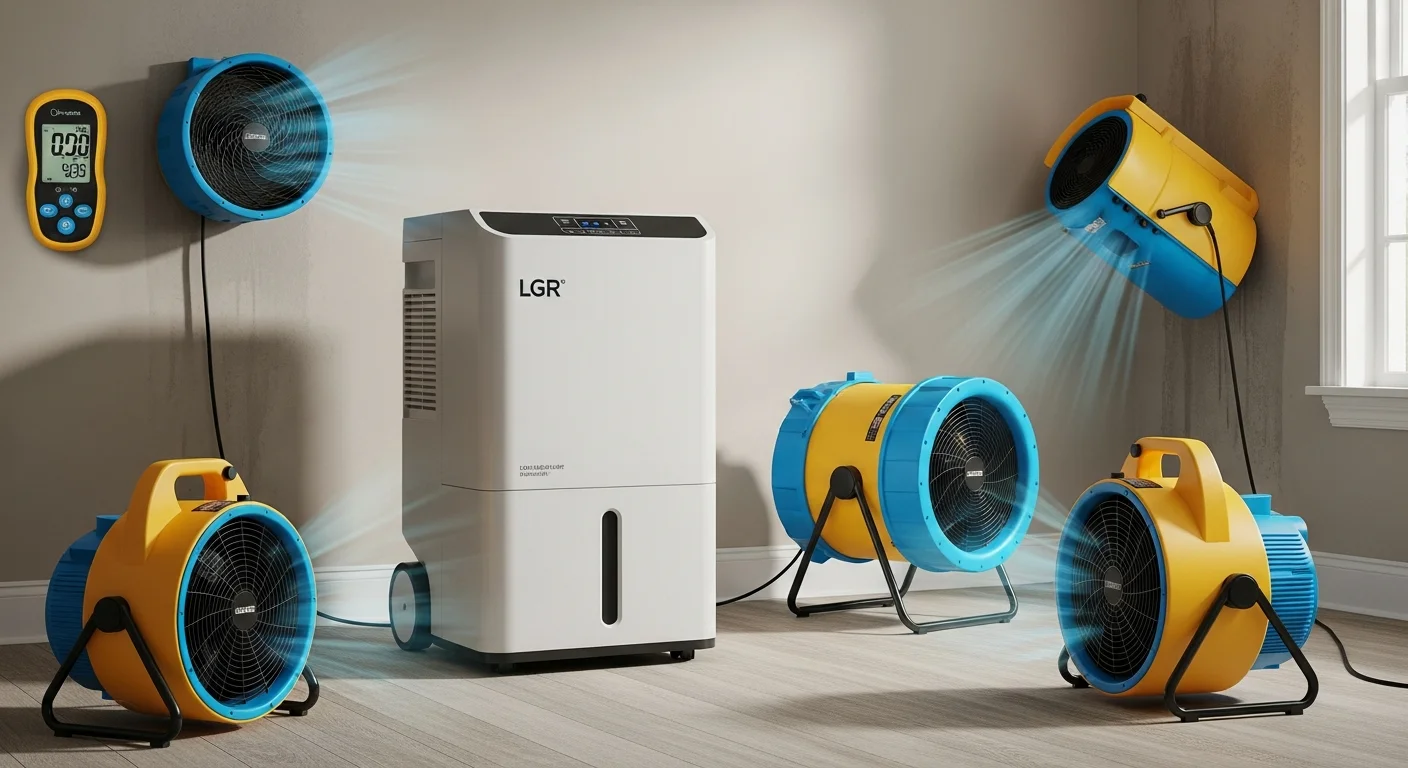
| Both together | Air movers feed water vapor to the dehumidifier; dehumidifier maintains low humidity for continuous evaporation | This is the only setup that actually dries structures |
Run only fans? You're spreading wet air around. Run only a dehumidifier? You're processing some room air without addressing the wet structure. Run both, sized correctly for the volume of moisture and the cubic feet of the space, and you have a drying setup.
Air Movers: What They Actually Do
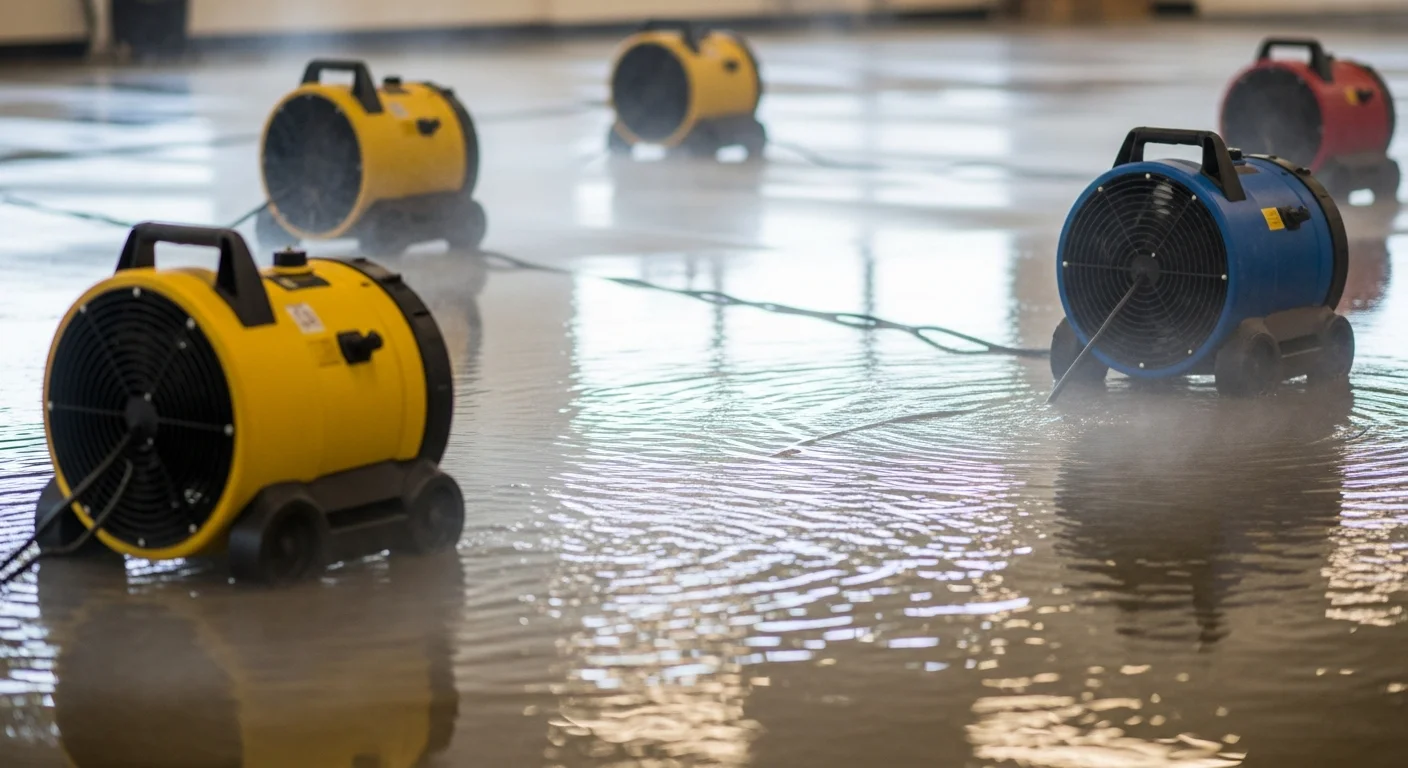
Air movers (sometimes called axial fans, snail blowers, or carpet dryers depending on shape) move very large volumes of air across surfaces — much higher velocity than a household fan. The job is mechanical: keep dry-ish air in contact with wet materials, push the resulting humid air away, repeat continuously.
What air movers do:
- Circulate high-velocity air across wet surfaces — floors, lower walls, exposed framing
- Carry evaporated moisture away from saturated materials
- Prevent stagnant humid microclimates from forming next to wet drywall and carpet
- Speed surface evaporation by orders of magnitude vs. still air
What air movers don't do:
- Remove moisture from the air. They redistribute it.
- Reduce the room's relative humidity
- Extract water from inside walls or insulation
- Achieve any drying without a complementary dehumidifier
Dehumidifiers: What They Actually Do
Dehumidifiers pull moist air through a cooled coil where water vapor condenses out, then return drier air to the room. The water collects in a tank or — in restoration use — drains continuously through a hose to a floor drain or out a window. The job is chemistry: lower the relative humidity of the room so wet materials can keep releasing moisture into it.
What dehumidifiers do:
- Remove moisture from the air (the rated capacity is typically pints per day at standard test conditions)
- Lower the room's relative humidity, which drives evaporation off wet surfaces
- Prevent re-condensation of moisture onto already-dry surfaces
- Create the conditions where materials can release moisture into the air rather than holding onto it
What dehumidifiers don't do:
- Move air across surfaces (that's the air mover's job)
- Directly dry visible wet areas
- Replace the airflow component of a drying setup
- Work without enough air movement bringing humid air to them
The Sponge Analogy (Why Both Are Needed)
Imagine drying a wet sponge in a sealed room.
Air mover only:
- Air mover blows air across the sponge
- Water evaporates from the sponge into the air
- The sealed room's air becomes saturated with moisture
- Saturated air cannot accept more moisture; evaporation slows to a crawl
- The sponge stops drying. (And so does your basement.)
Dehumidifier only:
- Dehumidifier pulls room air through, removes moisture, returns it
- Without airflow across the sponge, the immediate microclimate around the sponge stays humid
- The dehumidifier processes ambient air efficiently but the sponge dries very slowly
- Total drying time runs into weeks instead of days
Both together:
- Air mover blows air across the sponge — water evaporates into the airstream
- The dehumidifier pulls that humid air through, removes the moisture, returns dry air to the room
- The dry air returns to the sponge for another evaporation pass
- Continuous loop: evaporation → dehumidification → re-evaporation
- The sponge dries in days instead of weeks
This is why professional drying protocols always pair them. The ratio (number of air movers to dehumidifiers) gets calibrated based on room volume, material types, and ongoing moisture readings. It's drying science, not interior decorating.
Types of Dehumidifiers
Not all dehumidifiers work the same way. The three main types you'll encounter:
| Type | How It Works | Best For |
|---|---|---|
| Refrigerant (standard) | Cools air on a coil; water vapor condenses | Most residential and commercial scenarios above 65°F. Standard choice. |
| LGR (Low Grain Refrigerant) | Advanced refrigerant tech with pre-cooling | Professional drying. Effective at lower humidity levels (where standard refrigerant units stall). Removes more moisture per kWh. |
| Desiccant | Chemical adsorbent removes moisture | Cooler environments (under 65°F), unheated basements, very low humidity targets. Higher capacity in cold conditions. |
For most residential water damage, LGR is the standard professional choice. Desiccants come in for cold-environment jobs (winter basements, unheated structures). Standard refrigerant consumer units handle small spills but stall once the humidity gets low — they're efficient at "uncomfortable humid" → "comfortable" but inefficient at the deeper drying needed for structural moisture.
Why DIY Drying Often Fails
Homeowners rent a couple of fans and a small dehumidifier. The drying timeline triples, mold grows, and the eventual remediation costs more than the professionals would have. Why?
- Insufficient air volume. Consumer fans move a fraction of what restoration air movers move. The wet surfaces don't get the airflow they need.
- Insufficient dehumidification. Home dehumidifiers can't keep up with the evaporation load from a saturated room. The room's humidity rises faster than the unit can drop it.
- Hidden moisture. Without thermal imaging and moisture meters, you can't see (or address) water inside walls and under flooring.
- Wrong equipment for the conditions. Consumer refrigerant dehumidifiers don't work well below 65°F. In a cool basement, they're nearly useless.
- Coverage gaps. Hard-to-reach areas (closets, behind furniture, wall cavities) don't get the airflow or dehumidification they need.
- No verification. "It feels dry" is not "it is dry." Without a moisture meter, you're guessing whether you can stop. The guesses are usually optimistic.
Need Professional Drying Equipment?
Restoration companies bring industrial-grade equipment that consumer hardware stores don't stock — and the moisture-meter expertise to know when the job is actually done.
Find Water Damage Pros →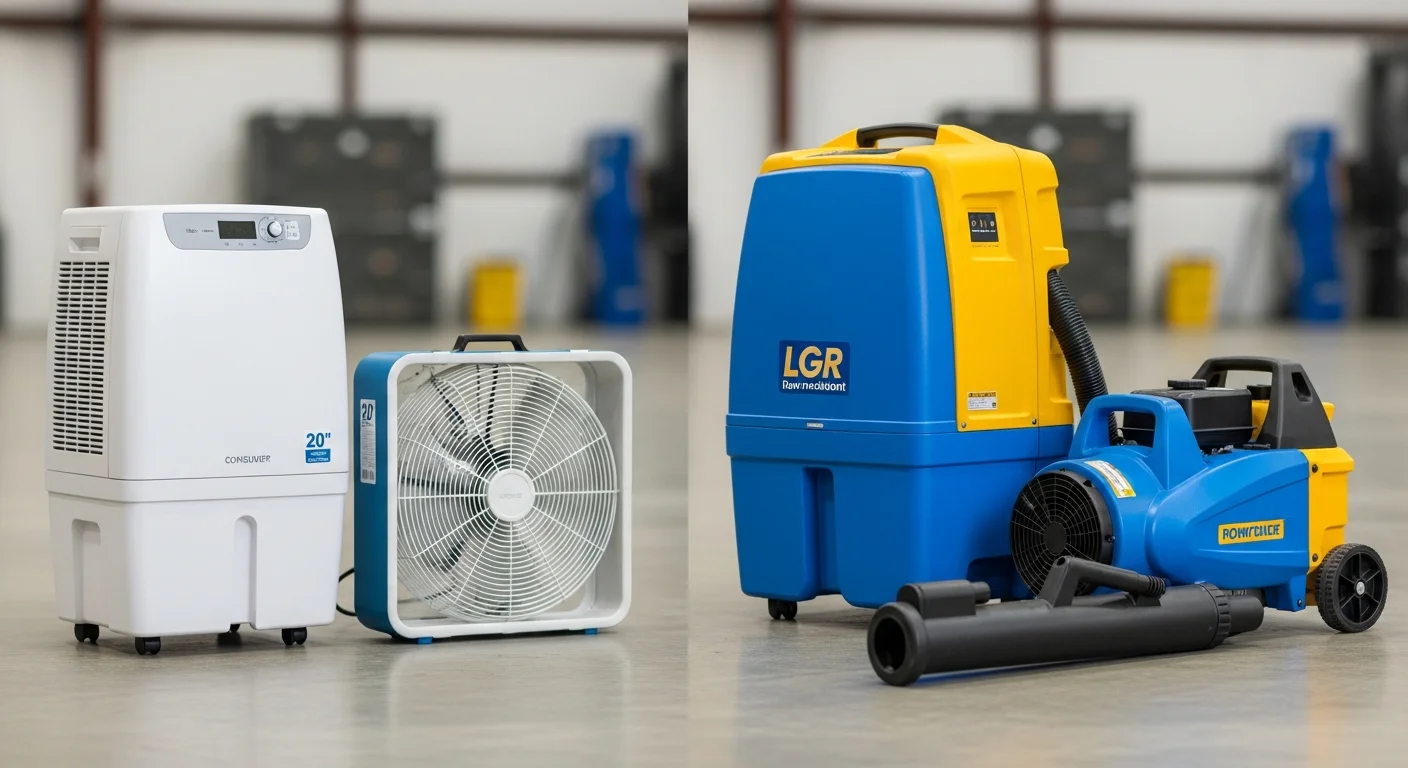
How Professionals Actually Set Up the Equipment
Professional drying isn't equipment scattered around hopefully. It's a calibrated system:
- Air movers are positioned to create directed airflow that reaches every wet surface — floors, lower walls, exposed framing if drywall is removed. Aimed, not just placed.
- Dehumidifiers are sized for the cubic footage and the projected moisture load. A small room with one wet wall doesn't need a 200-pint LGR; a basement with three wet walls and saturated insulation might need two.
- Equipment is monitored daily with moisture meters. Readings track downward; if they don't, the setup gets adjusted.
- Configuration is adjusted as materials dry. The setup that's right on day 1 isn't right on day 4 — equipment moves to address slower-drying areas.
- Thermal imaging identifies wet areas that aren't visible — moisture behind drywall, under flooring, in HVAC ducts — so they get addressed too.
Frequently Asked Questions
How long does professional drying take?
Typically 3–7 days for moderate water damage; 7–14 days for severe saturation; 2–3 weeks for very deep structural cases. The process can't be safely rushed without risking incomplete drying (mold risk) or structural damage from drying too aggressively. Daily moisture meter readings determine when the equipment can come down — not the calendar.
Can I just use fans instead of renting professional equipment?
For very minor spills (a few inches of clean water on a small hard-surface area, addressed within hours), fans alone might handle surface evaporation if the area is well-ventilated. For anything significant — soaked carpet pad, wet drywall, structural saturation — fans alone won't extract enough moisture. Without dehumidification, you're spreading the moisture around, not removing it. Hidden moisture problems lead to mold within 24–48 hours.
Should I run the air conditioning to help dry?
Yes — AC acts as a partial dehumidifier as it cools, removing some moisture from the air. This helps in moderate-temperature climates. Caveats: AC systems aren't designed for continuous operation under heavy moisture loads (the coils and drain pans can fail), AC alone is far less effective than a real dehumidifier, and if the HVAC system itself was affected by the water event you should NOT run it (you'd redistribute contaminated moisture throughout the home).
How do professionals know when drying is complete?
Moisture meters measure the moisture content of building materials. Professionals compare readings in the affected area against readings from unaffected reference areas in the same home, and track them over multiple days. Drying is considered complete when affected materials match normal baseline readings (typically under 1% for drywall, under 16% for wood framing). Surface dryness and "feels dry" are not acceptable verification methods.
Can I rent professional drying equipment myself?
Yes, restoration equipment is available at rental yards. LGR dehumidifiers run $50–$80/day; air movers $25–$40/day. Plan for 3–7 days of rental. The catch: you also need a moisture meter to verify drying, knowledge of how to position equipment effectively, and the discipline to run it 24/7. Most homeowners who rent equipment underestimate the duration and miss hidden moisture, which is why insurance often prefers professional drying — they document everything for the claim.
Is one large dehumidifier better than several small ones?
Generally yes for residential drying — a single LGR dehumidifier covers more area, removes moisture more efficiently per kWh, and is the standard professional approach. Multiple smaller consumer dehumidifiers can collectively handle a moderate load but are less efficient and don't perform well at low humidity levels (where deeper drying happens). For DIY rentals, prefer one larger unit over two small ones.
Equipment Reference
If you're DIY-renting or buying for a future event, here's what professionals use:
- LGR Commercial Dehumidifier — Low Grain Refrigerant tech is what restoration companies use. Removes moisture even at low humidity levels where consumer units stall.
- Restoration Air Mover — designed to direct high-velocity airflow specifically across wet surfaces. Very different from a box fan in airflow volume and direction.
- Moisture Meter — the verification tool. Without this, you don't know when to stop.
The pithy version: air movers turn wet structures into wet air; dehumidifiers turn wet air into dry air; the two together turn a flooded room back into a habitable one. Run one without the other and you've got performance art. Run both correctly with daily moisture readings and you've got a working drying system. (Marco's father insisted in 2019 that "fans are basically the same thing" and ran four box fans in a flooded basement for ten days. The mold remediation took three months. He now refers to dehumidifiers as "the smart cousins of fans," which is unfair to fans but admirably specific.)
This post contains affiliate links. If you use them to find a contractor or product, we may earn a commission at no extra cost to you.