
How do you find a legitimate water damage restoration company near you? You must verify their IICRC certification on the official IICRC Global Locator, demand proof of active general liability and workers' compensation insurance, and refuse to sign an "Assignment of Benefits" contract. Never hire a company that demands a massive upfront deposit in cash.
When there is two inches of water in your living room, you are panicked. You just want someone with a loud truck and a shop vacuum to show up and make the water go away. The restoration industry knows this, and unfortunately, predatory "storm chasers" thrive on that exact panic.
The difference between a certified restoration professional and a guy with a fan in his van is massive. The wrong company will leave hidden moisture in your wall cavities (guaranteeing a future mold problem), submit terrible documentation (guaranteeing your insurance claim is denied), or legally hijack your insurance payout. Here is exactly how to vet a company before you let them through your front door.
The Non-Negotiable Credential: IICRC Certification
The Institute of Inspection, Cleaning and Restoration Certification (IICRC) is the governing body for the restoration industry. Specifically, you want a company whose lead technicians hold the Water Damage Restoration Technician (WRT) and Applied Structural Drying (ASD) certifications.
Do not just take their word for it. Scammers frequently put fake IICRC logos on their websites.
| The Claim | The Reality Check |
|---|---|
| "We are fully certified." | Go to iicrc.org/iicrcgloballocator. Type in their company name. If they are not in the database, they are lying to you. |
| "We are licensed and insured." | Ask their insurance broker to email you their Certificate of Insurance (COI). You need a minimum of $1M General Liability and active Workers' Compensation. |
| "We're local." | Check their Google Business Profile. Do they have a physical address, or is it a P.O. Box? Are they a national call center just sub-contracting out to the lowest bidder? |
The "Assignment of Benefits" Trap
Before a company starts extracting water, they will hand you a contract. Read it carefully. You are looking for a clause called the Assignment of Benefits (AOB).
An AOB transfers your legal rights regarding your insurance claim over to the restoration company. They get to bill your insurance company directly, and the insurance company cuts the check directly to them.
While some legitimate companies use AOBs to streamline the process, predatory companies use them to hold homeowners hostage. If they do shoddy work, or if they wildly over-bill the insurance company and your insurer refuses to pay the inflated rate, an AOB makes it incredibly difficult for you to fire the contractor or dispute the charges. You have legally given away your leverage. Proceed with extreme caution before signing an AOB.

Evaluating the Estimate
A professional restoration company will provide a highly detailed, itemized estimate based on industry-standard pricing software (usually Xactimate).
| A Legitimate Estimate Includes: | A Red Flag Estimate Looks Like: |
|---|---|
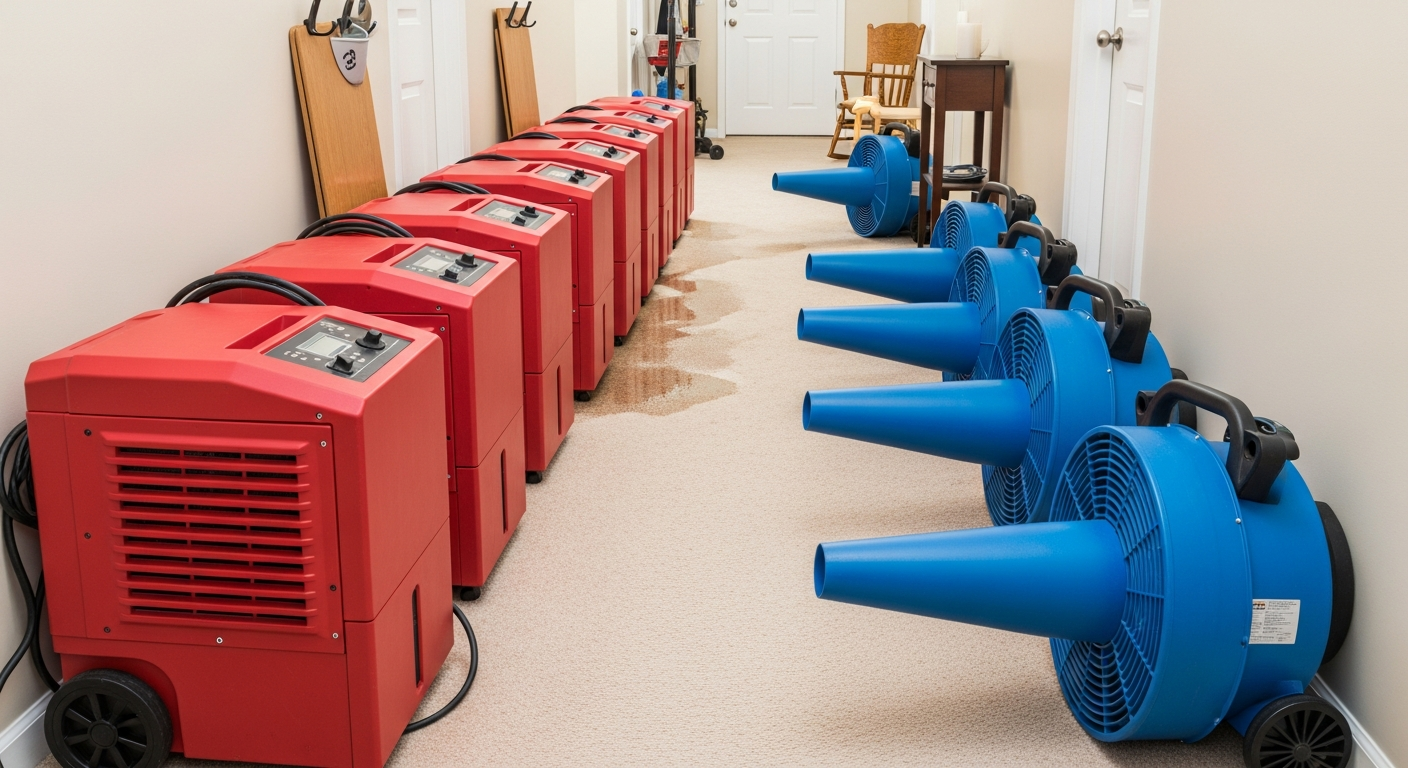
| Exact counts of equipment (e.g., 4 LGR dehumidifiers, 12 air movers). | "Drying equipment rental" |
| Square footage of materials being removed (e.g., tear out 150 sq ft of carpet). | "Demolition services" |
| Antimicrobial application mapped by the square foot. | "Mold prevention spray" |
| Daily moisture monitoring logs built into the timeline. | A blank "TBD" for the project duration. |
Frequently Asked Questions
How do I choose a water damage restoration company near me?
First, verify their IICRC firm certification at iicrc.org. Second, request a Certificate of Insurance showing active liability and workers' compensation coverage. Third, ask if they provide daily moisture monitoring logs (which your insurance adjuster will want to see). Finally, check local Google reviews to ensure they are a physically local business, not an out-of-state "storm chaser."
What questions should I ask a water damage restoration company?
Ask them: Are your crew chiefs IICRC WRT-certified? Do you use Xactimate for your billing? Do your contracts include an Assignment of Benefits (AOB) clause? Will you provide daily moisture readings throughout the drying process? Do you handle the reconstruction phase, or just the emergency mitigation?
What is the difference between water mitigation and water restoration?
Water mitigation is the emergency phase: extracting standing water, tearing out ruined drywall, and running industrial dehumidifiers to stop the damage. Water restoration (often called reconstruction) is the rebuild phase: hanging new drywall, painting, and laying new carpet. Many companies do both, but you are not obligated to use the same company for the rebuild that you used for the mitigation.
Why is my insurance company recommending a specific restoration contractor?
Insurance companies have "preferred vendor" networks. These are contractors who have agreed to work at pre-negotiated rates for the insurer. While this can make the claims process smoother, remember that the preferred vendor answers to the insurance company, not to you. By law, you have the right to hire any certified restoration contractor you choose.
Ready to connect with a certified professional? Find restoration services near you through our verified contractor network.