
What should I do if my basement is flooding right now? Don't enter if water is touching electrical anything. Shut off power at the breaker only if you can reach it dry. Turn off the main water valve. Move people and pets to upper floors. Photograph everything before you touch it. Then call a 24/7 restoration company. The first 30 minutes decide most of the outcome.
If you're reading this with one foot already in the basement, stop. Step back. Read the first sentence again. (We're going to be efficient here — this isn't the moment for our usual three paragraphs of small talk.) The next half hour is going to do most of the deciding for you. Get it right and you've got a manageable cleanup. Get it wrong and the damage curve goes vertical.
Call a 24/7 Emergency Restoration Service Now
Water extraction within the first 24 hours dramatically reduces mold risk and structural damage cost.
Find 24/7 Restoration Pros →Step 1: Electrical Safety (Non-Negotiable)
Before you do anything else, look at where the water is and where your electrical stuff is. If your basement has any outlets, appliances, or your circuit breaker panel — especially the breaker panel — water near any of them turns the basement into a high-stakes physics demonstration. The rules:
- Do NOT enter if water is touching or near electrical sources
- If you can reach your circuit breaker safely (dry path, dry hands), shut off power to the basement
- Never touch breakers or outlets while standing in water. Even a little water.
- If the breaker box itself is in the flooded area, leave the basement, close the door, and call your utility to disconnect at the meter
Step 2: Stop the Source If You Can Reach It Safely
If you can identify the source from a safe vantage point, here's the playbook by cause:
- Burst pipe: Turn off the main water valve. It's usually near where the main water line enters the house — often by the water meter, sometimes inside a utility room. Turn it clockwise (righty-tighty). If you don't know where yours is, today is the worst day to find out — but go find it anyway.
- Sump pump failure: Check if it's unplugged, the float is stuck, or the breaker tripped. A stuck float is the most common cause and a 60-second fix.
- Sewer backup: Stop using all water in the house immediately — every flush and every shower adds to the problem. Call a plumber. Do NOT enter the affected area without protective gear (sewage is Category 3 contaminated water).
- Storm flooding: You can't stop rain (which is, on reflection, why we have insurance). You CAN redirect surface flow with sandbags at the lowest entry points and clear gutters and downspouts upstream of the basement.
- Foundation seepage: Likely groundwater pushing through cracks. Standard homeowners usually doesn't cover this. Mark the location for the contractor and move on.
If the source isn't obvious or isn't safe to reach, skip this step. The pros will find it.
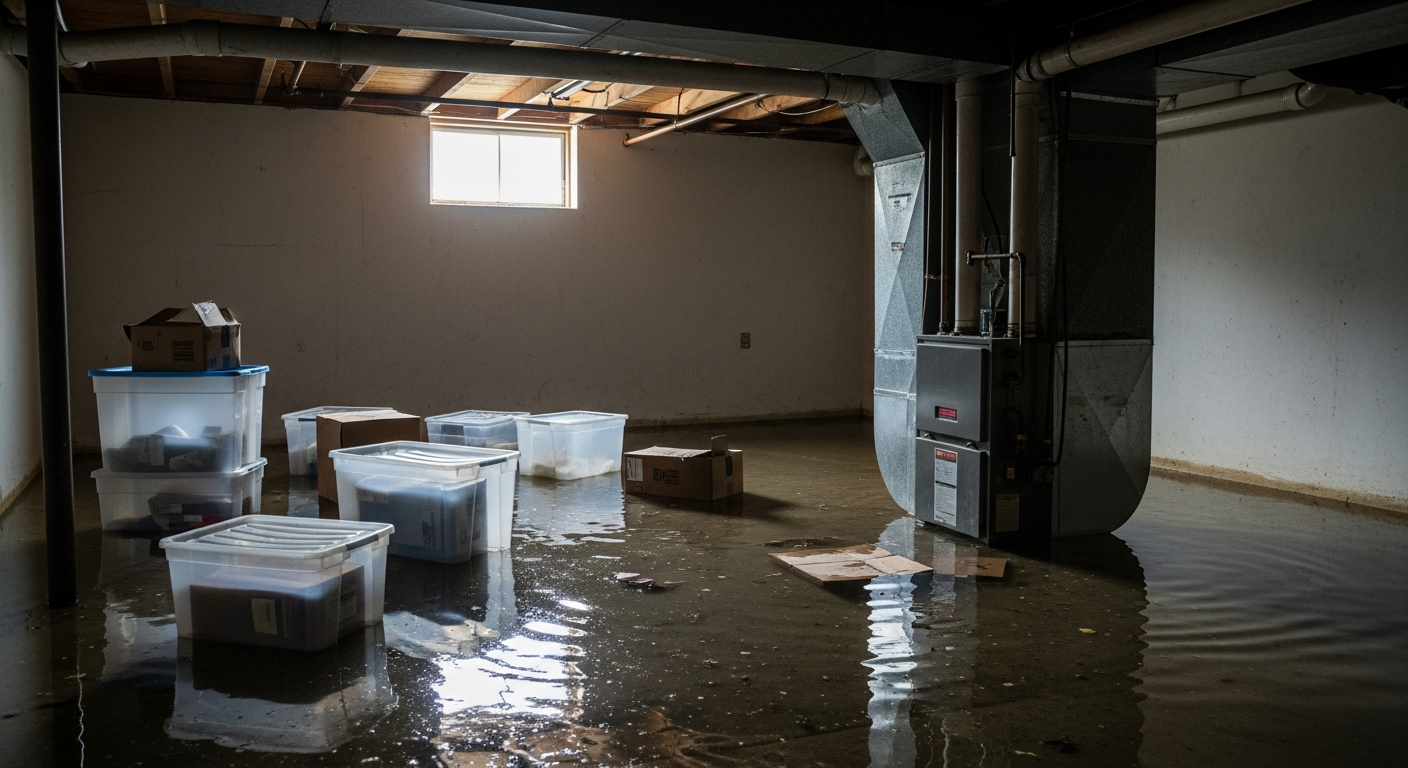
Step 3: Protect Your Family (and Pets, and the Drumkit)
- Move family members — especially children, the elderly, and pets — to upper floors
- If water is rising rapidly or the structure is showing distress (cracking, bulging walls, ceiling sagging on the floor above), leave the house entirely
- Don't try to save belongings if it puts anyone at risk. The drumkit is replaceable. (Marco's drumkit was. Marco was inconsolable for a week, but he was inconsolable from the upstairs couch, which was the right outcome.)
- If anyone has been exposed to potentially contaminated water — sewage, floodwater, anything murky — watch for symptoms (rash, nausea, GI distress) and consult a doctor
Step 4: Document Before You Touch Anything
From a safe vantage point — top of the stairs is fine — get the photographic record. Insurance adjusters do not work on faith. They work on documentation.
- Photograph the water level with visible markers in frame (the third stair, the height of the dryer, anything that gives scale)
- Capture the source if it's visible — pipe, drain, window, floor crack
- Take wide video sweeps from the doorway. Talk through what you're seeing if your phone supports voice.
- Get timestamps on every photo (most phones do this automatically; double-check)
- Photograph stored items, the furnace, water heater, washer/dryer if visible — anything that's clearly affected
Step 5: Remove Water Safely (Only If You Can)
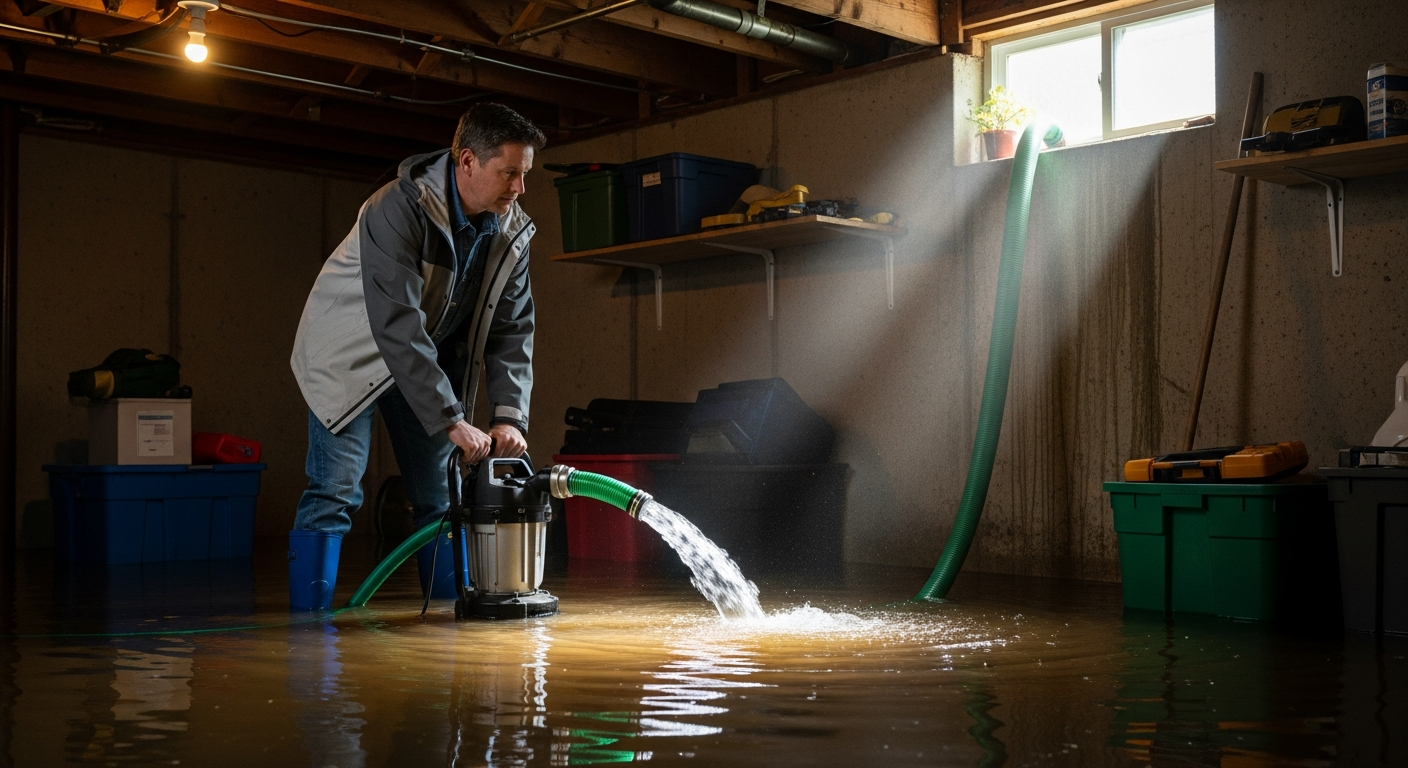
If the water is less than a few inches deep and demonstrably clean (a burst supply line, an ice maker, a clean roof leak), you can start removing it while waiting for the pros. Conditions: no electrical hazards anywhere in the work area, no smell of sewage, no floodwater contamination.
- A wet/dry shop vac handles small volumes on hard floors. Empty it constantly — they fill fast.
- Portable submersible pumps work for larger volumes; connect to a garden hose and direct outside, ideally at a downhill grade away from the foundation
- Move salvageable items (electronics, photos, important paperwork) to dry areas
- Place sandbags or rolled towels at doorways to slow further water entry from upstream
Step 6: Call the Professionals (Sooner Beats Later)
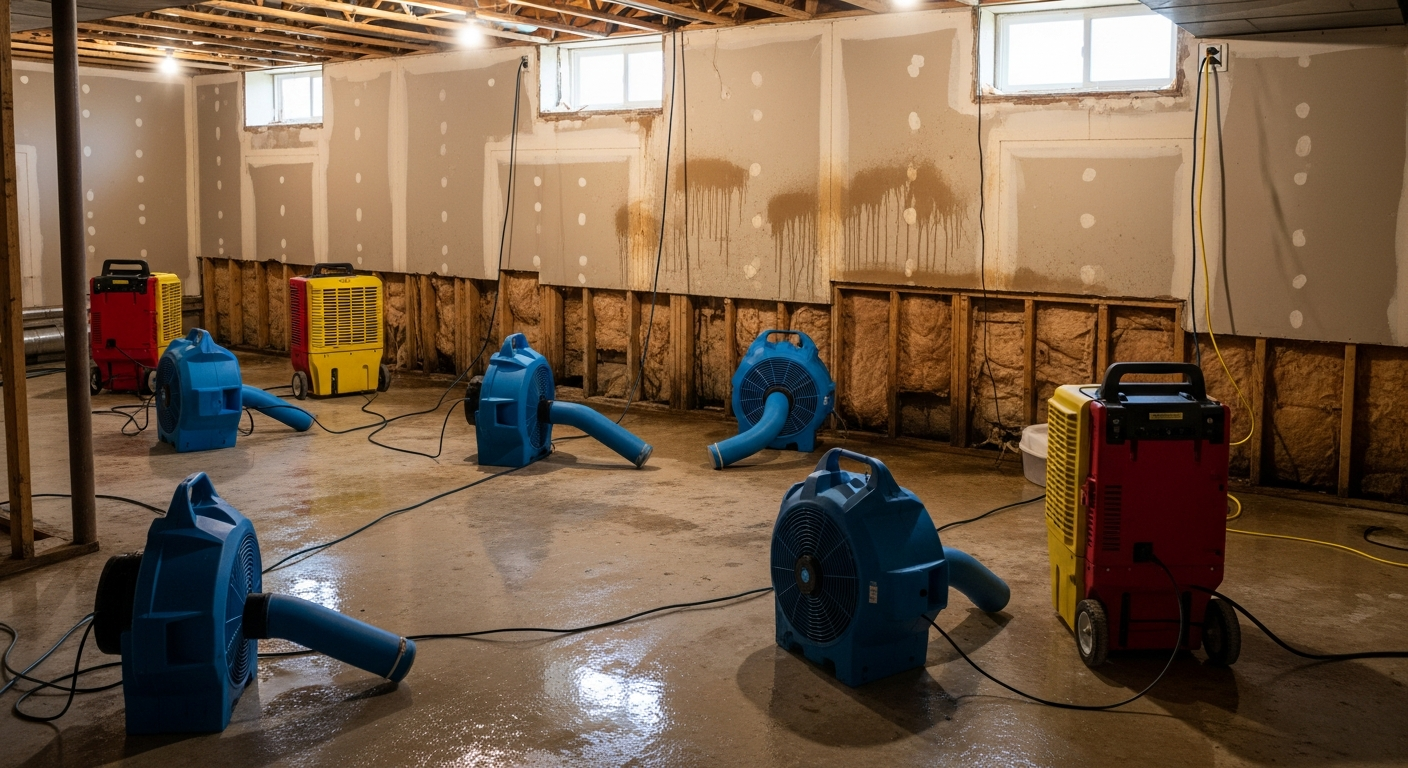
Professional restoration crews bring tools that the local hardware store does not stock. The difference matters most in the first 24 hours, which is also the difference between mitigation and remediation.
- Industrial-grade pumps that move thousands of gallons per hour, not the 50–100 gallons per hour your shop vac is gallantly attempting
- Commercial LGR dehumidifiers that pull 80–200 pints of water per day out of the air and structure (consumer dehumidifiers manage 30–50 on a good day)
- Moisture meters that measure water inside the wall cavity, not just on the surface
- Thermal cameras for finding saturation behind drywall and under flooring
- Antimicrobial treatments that pre-empt mold growth in the 24–48 hour window before it establishes
Find Certified Restoration Pros — Available 24/7
Fast professional response is the cheapest part of the whole job in the long run.
Get Emergency Help Now →What NOT to Do (the List That Saves the Most Money)
- Don't wait to call. Every hour of standing water adds material damage and material risk. The "let me see if it dries on its own" approach is how a $4,000 mitigation becomes a $14,000 mold remediation.
- Don't use box fans without dehumidifiers. Fans without humidity removal just push wet air around. The moisture stays in the structure; you're just giving it a tour.
- Don't throw anything away yet. Document first, throw out later. Adjusters need to see what was damaged to write the right scope.
- Don't ignore "hidden" water. Water that wicks behind baseboards and into wall cavities causes mold that isn't visible for weeks. Moisture meter readings — not eyeballs — confirm dryness.
- Don't rebuild before moisture testing confirms the structure is dry. Sealing wet drywall under fresh paint is the construction equivalent of locking a problem in a box and labelling it "future you's problem."
- Don't sign Assignment of Benefits forms in the first 48 hours. If a contractor asks you to sign over your insurance rights before they've assessed the damage, that's a flag. Real ones don't need it.
Will Insurance Cover This?
Basement flooding coverage depends entirely on the cause. The general rules:
- Sudden burst pipe: Usually covered under standard homeowners insurance.
- Appliance failure (washer hose, water heater rupture): Usually covered under standard homeowners insurance.
- Sump pump failure: Usually requires a sump pump endorsement (a small policy add-on that runs $50–$150/yr and pays for itself the first time you need it).
- Sewage backup: Requires specific sewer backup coverage. Often a separate endorsement, often capped at $5,000–$25,000.
- Groundwater seepage through foundation cracks: Almost always NOT covered — it's classified as a maintenance issue.
- Storm flooding (water rising from outside): Requires NFIP or private flood insurance. Standard homeowners explicitly excludes it.
Read your declarations page (the summary at the front of your policy) to see which endorsements you actually have. The time to discover you don't have sump pump coverage is, regrettably, every time before this one. Read more on water damage insurance coverage.
Frequently Asked Questions
How fast does mold grow after basement flooding?
Mold spores establish within 24–48 hours of water exposure on porous materials (drywall, insulation, carpet padding, particleboard). Visible mold growth is typically apparent within a week. Fast extraction and aggressive drying within the first 48 hours is the most cost-effective mold prevention available — once mold is established, you're paying for remediation, not just mitigation.
Should I pump out my basement myself?
Only if the water is clean (Category 1), shallow, no electrical hazards exist anywhere in the work area, and you have appropriate equipment (wet/dry vac or portable pump). For sewage, deep flooding, or contaminated water, professional remediation is required. Pumping a deep basement out too fast can also cause structural damage to the foundation — water pressure outside the wall holds it in place; remove it too quickly and the wall can crack or bow inward.
How long does basement water damage restoration take?
Minor flooding (a few inches of clean water): 3–7 days for full mitigation and drying. Major flooding with saturated walls and structural materials: 1–3 weeks for mitigation alone, plus reconstruction time. Sewage contamination: 2–4 weeks for remediation alone (containment, demolition of porous materials, antimicrobial treatment), plus reconstruction time. Reconstruction typically adds another 1–6 months depending on scope.
Can I stay in my home during basement flooding restoration?
Usually yes if the flooding is contained to the basement and the rest of the home is unaffected. Exceptions: sewage contamination (HVAC system may be compromised, redistributing pathogens), flooding that affected the main electrical panel, or any case where the work crew needs to demo extensively. If you're displaced, your homeowners policy's Additional Living Expenses (ALE) provision typically covers temporary housing.
How much does basement water damage cleanup cost?
Typical costs in 2026: minor clean-water flooding $1,500 to $4,500 (extraction, drying, minor demo). Major clean-water flooding with structural saturation $4,500 to $12,000. Sewage backup remediation $7,000 to $25,000+ depending on contamination scope. Costs scale with water category, square footage, time before mitigation began, and how much porous material had to be removed and replaced.
Will my basement flood again?
Statistically, basements that have flooded once are more likely to flood again than basements that haven't — usually because the underlying cause (drainage issues, sump pump capacity, foundation cracks, sewer line condition) is unresolved. After cleanup, address the root cause: french drains, exterior grading, sump pump upgrade with battery backup, sewer line inspection, or backflow preventer installation. The remediation prevents the flood from being worse next time.
Emergency Supplies Worth Having on Hand
If the flooding is minor and safe to address while waiting for professionals, these tools limit damage. (None of them belong in your basement, but every one of them belongs in your garage.)
- Wet/Dry Shop Vac — extracts standing water from hard floors quickly. Do NOT use on sewage water or near electrical sources.
- Portable Submersible Pump — for larger volumes of clean water. Connects to a garden hose to direct water outside. Cheap insurance for a flooded basement.
- Commercial Dehumidifier (70-pint or larger) — pulls moisture from the air after extraction. Consumer-grade units are too small for a flooded basement; look for 70-pint or larger.
A flooded basement is rarely good news, but it's almost always recoverable when you act quickly and resist the urge to be heroic. Cut the power, turn off the water, document the scene, call the pros, and let the equipment do the heavy lifting. (Marco rebuilt his basement once. The drumkit, miraculously, came back. He plays slightly more quietly now, which his wife has officially declared "the silver lining of the 2003 storm.")
This post contains affiliate links. If you use them to find a contractor, we may earn a commission at no extra cost to you.